A baby hognose often feels safer in a 5-gallon tub than a big tank. One colubrid breeder tells new owners exactly that, and it’s the first surprise in western hognose snake care.
Too much open space can put a young hognose off its food, and a baby that skips meals for weeks will test any new owner’s patience. The rest of the setup comes down to a short list of numbers: heat, humidity, prey size and how long to wait before you touch your new snake.
The 8 steps get every one of those numbers right, plus the warning signs that mean it’s time for a vet. Step 8 also gives the breeder’s settling-in rule, which is no handling until your snake has eaten 2 or 3 meals without problems.
How to Care for a Western Hognose Snake Step by Step
Western hognose snake care takes 8 steps: check the law, set up a 36 x 18 x 18 inch enclosure, add deep substrate and hides, heat a 90-95°F basking spot, add UVB, hold humidity at 30-50%, feed frozen-thawed mice and handle only once the snake eats.
The western hognose, Heterodon nasicus, is a small burrowing snake in the Colubridae family, native to the dry plains of western North America. Its upturned snout is a digging tool, so most of these steps are about giving it loose ground and a warm, dry home.
Step 1: Check That a Hognose Is Legal Where You Live
Check your state and city rules before you buy, because a western hognose isn’t legal everywhere in the US.
ReptiFiles, a widely used reptile husbandry reference, warns that hognose snakes are illegal to keep in some parts of the country. It tells keepers to look up state and local laws for possible bans.
So start with your state wildlife agency’s website and your city’s animal ordinance, and get any permit you need before the snake comes home.
Step 2: Set Up a 36 x 18 x 18 Inch Enclosure
An adult western hognose does best in an enclosure of about 36 x 18 x 18 inches, the size ReptiFiles lists in its quick facts.
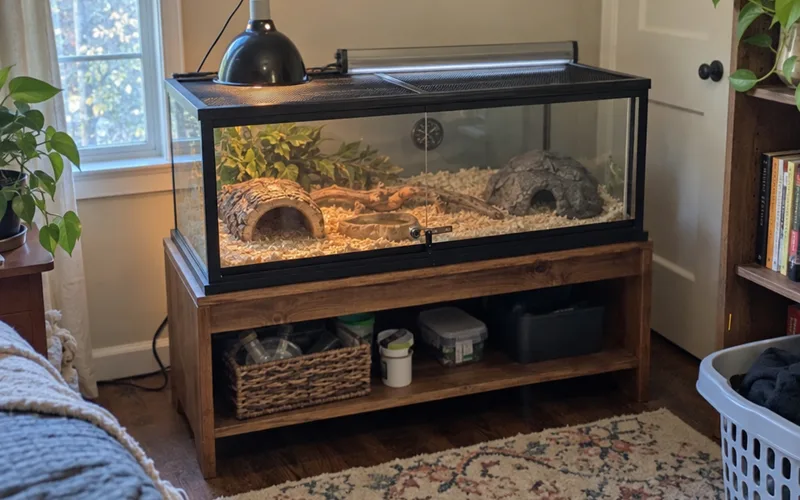
Floor space matters more than height, because hognoses live on and under the ground and don’t climb much.
Size also depends on the snake’s sex. ReptiFiles says hognoses range from about 14 to 46 inches long by sex and species, with females much larger than males, and the hognose snake size breakdown shows how that plays out by age.
That’s why a 20-gallon tank, the smallest adult size you’ll see on care sheets, can work for a small male but cramps a big female.
Hatchlings are the exception.
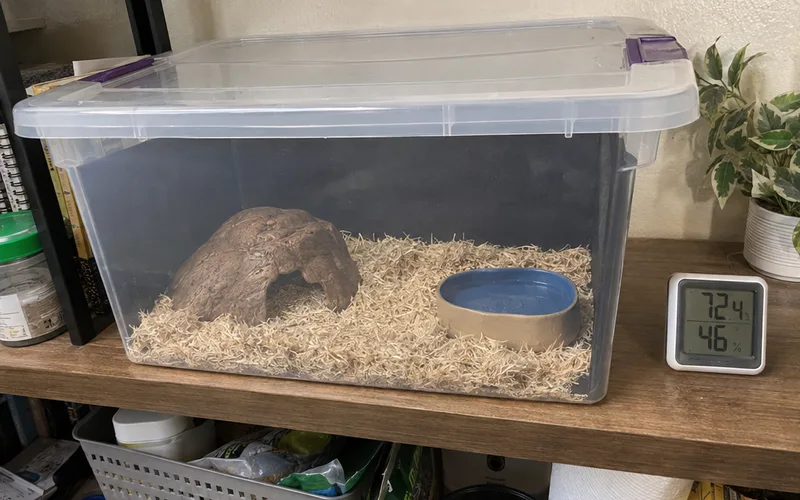
A breeder posting on the MorphMarket forum recommends nothing larger than a 5 gallon enclosure at first, with 3 sides blacked out. Baby hognoses like tight, hidden spaces, and a big open tank can put them off food.
Whatever the size, lock it down.
Hognoses push up with their snouts, so use cage clips or a front-opening enclosure with secure doors.
Step 3: Add Deep, Loose Substrate and 2 Hides
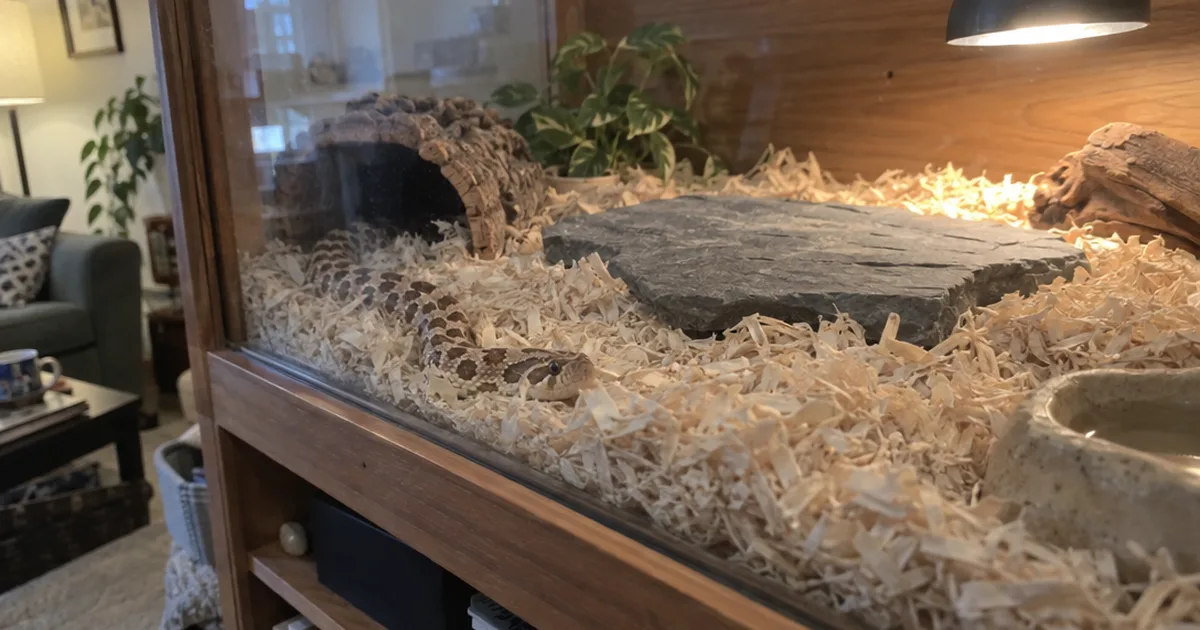
Give a western hognose at least 4 inches of loose, dry substrate, such as aspen shavings or an arid soil and sand mix, so it can dig and bury itself.
Burrowing is how a hognose rests and hides, so this layer matters more than any decor.
Aspen is the easy choice: it’s cheap, holds burrows and is simple to spot clean. If you want something more natural, a mix of topsoil and sand works well, and it can support a bioactive setup with live plants.
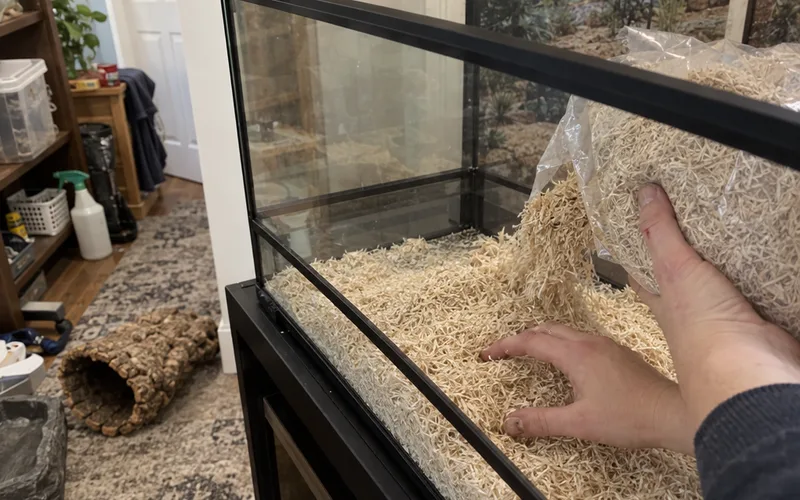
Here’s what to skip:
- Pine and cedar shavings, because their oils can harm snakes
- Fine loose sand on its own, which can be swallowed with food
- Damp, heavy bedding that drives humidity up
Hatchlings can start on paper towel or a thin layer of aspen until they’re eating well.
Next, add 2 snug hides, one at the warm end and one at the cool end, so your snake never has to choose between feeling safe and staying at the right temperature.
Flat stones, cork bark and fake plants give it things to crawl over. A cluttered enclosure is a calmer enclosure for a hognose.
Step 4: Heat a 90-95°F Basking Spot Over a 70-75°F Cool Side
A western hognose needs a basking surface of 90-95°F at one end and a cool side of 70-75°F at the other, according to ReptiFiles’ hognose quick facts.
That spread is a temperature gradient. Your snake moves along it to warm up after a meal or cool down when it’s had enough.
Here’s how to build it:
- Put a halogen basking bulb over one end, aiming to heat about a third of the enclosure.
- Place a flat stone or slate under the bulb as the basking surface.
- Plug the bulb into a dimming thermostat so the spot can’t overheat.
- Check the stone with an infrared temperature gun, then confirm the cool end with a digital thermometer.
Measure the surface, not the air, because the stone is what your snake actually lies on.
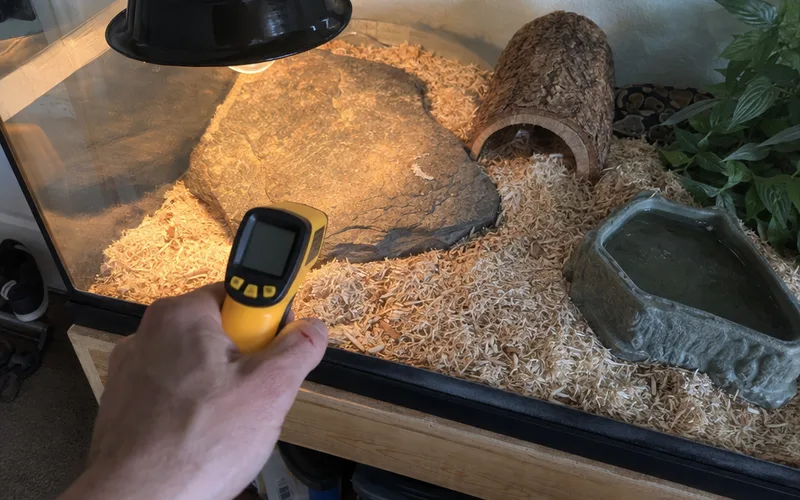
At night, turn the lights off.
If your room gets much colder than the cool-side range, a heat mat on a thermostat under the warm end keeps a gentle warm patch without any light.
Step 5: Add Low-Output UVB on a 12-Hour Day
Western hognose snakes can live without UVB, but a low-output UVB tube is worth adding, and ReptiFiles’ guide lists a UV index (UVI) of 2.0-3.0 as the target.
UVB is the part of sunlight that helps reptiles make vitamin D3. Hognoses are diurnal, meaning active during the day, so they’d get some sun in the wild.
A 5% or 6% T5 UVB tube over the warm half of the enclosure is the usual pick for this size.
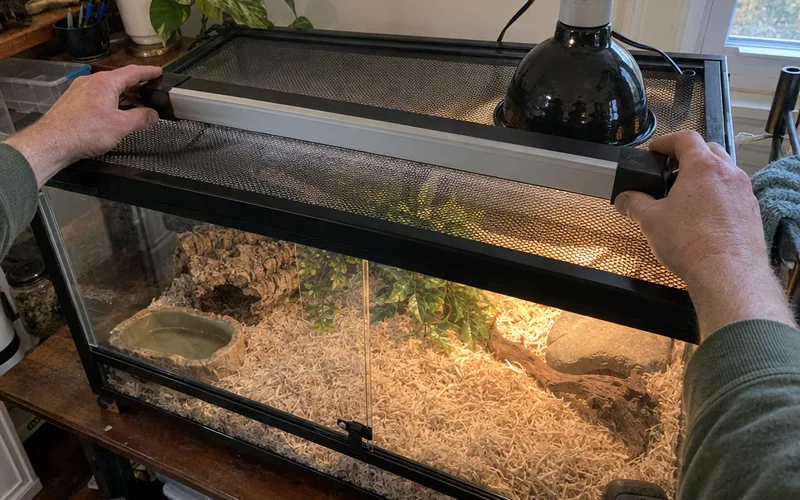
Run it and the basking bulb on a timer for 10 to 12 hours a day, then switch everything off at night.
Replace the UVB tube every 12 months, because its UVB output fades with use.
Step 6: Keep Humidity at 30-50% With a Clean Water Bowl
Western hognose snakes need low to moderate humidity of 30-50%, the range ReptiFiles gives, with most of the moisture down in the substrate rather than in the air.
Too much humidity is the bigger risk for this species, since damp, stuffy enclosures are linked to respiratory infections.
Put a digital hygrometer probe in the middle of the enclosure and check it daily.
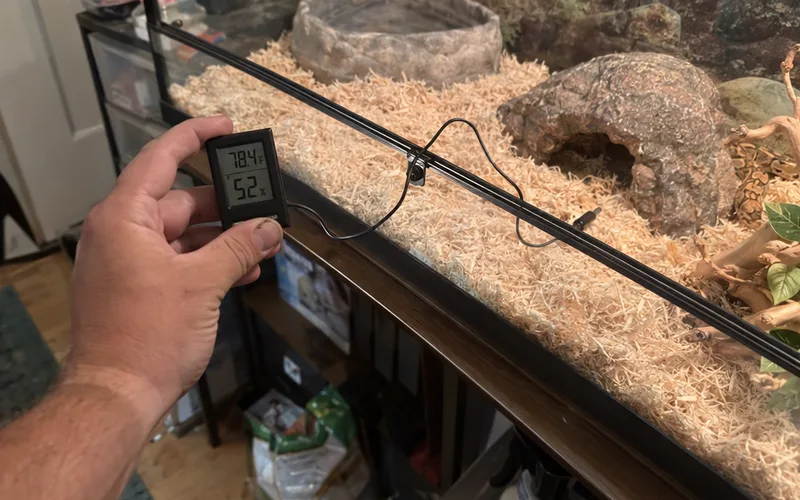
If the reading runs high, add ventilation or move the water bowl to the cool end. If it runs low, lightly mist one corner of the substrate.
Speaking of water, keep a large, shallow bowl out at all times.
Change it at least twice a week, or right away if it’s soiled, and scrub the bowl before you refill it.
Step 7: Feed Frozen-Thawed Mice on a Schedule
Feed a western hognose frozen-thawed mice about as wide as the widest part of its body: a pinky mouse about once a week for hatchlings, and one mouse every 7 to 14 days for adults.
Wild hognoses eat mostly toads and other amphibians, but captive ones do well on rodents. Frozen-thawed prey is safer than live prey, which can bite or scratch your snake.
The routine is simple:
- Thaw the mouse completely before you offer it.
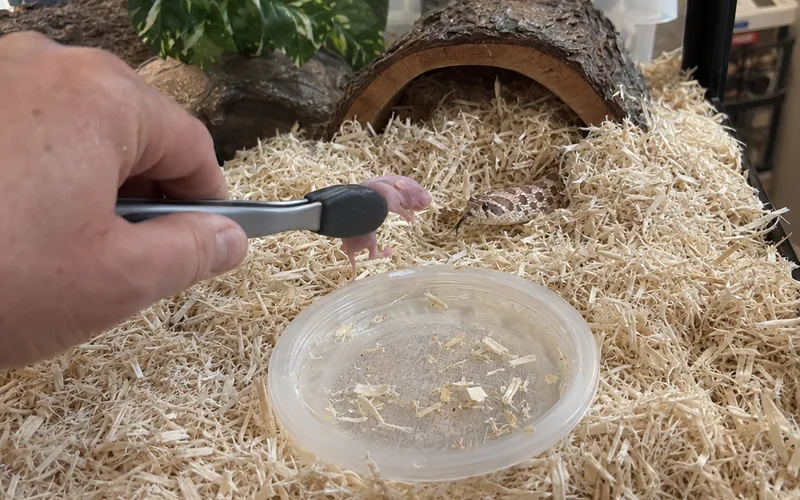
- Offer it with soft-tipped tongs, or leave it on a deli cup lid near the snake.
- Leave the prey for a few hours, or overnight for a shy eater, then remove it.
The lid helps more than it looks. Hognoses strike messily, and feeding off the bedding lowers the chance of swallowing substrate.
The catch?
Hognoses are famously picky, especially as babies.
The MorphMarket breeder says not to offer food more often than every 4 days, and that hatchlings can go months without eating with no ill effect. So if your snake refuses, wait for the next feeding day instead of trying again tomorrow.
Many keepers also see appetite drop from about November through February, a natural winter slowdown called brumation.
Keep offering food on schedule and weigh your snake weekly, since steady weight matters more than a missed meal. The reptile brumation explainer covers what that slowdown looks like.
For prey sizes by age, scenting tricks and switching a picky eater to mice, the full hognose snake diet has the details.
Step 8: Let It Settle, Then Handle Gently
Leave a new western hognose alone for at least a week, and don’t handle it until it has eaten 2 or 3 meals without problems.
That’s the rule the MorphMarket breeder sends home with every hatchling, and it gives a stressed snake time to start eating.
Once your hognose is feeding well, handle it 1 to 2 times a week for a few minutes.
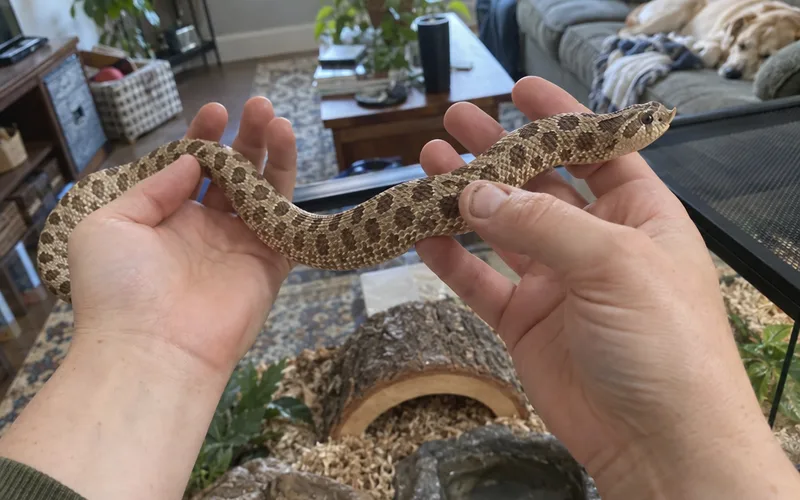
Wash your hands first, so they don’t smell like food. Then scoop the snake up from below with 2 hands, supporting its body, and never lift it by the tail.
Skip handling in 2 situations:
- For 48 hours after a meal, because handling too soon can cause regurgitation
- When its eyes turn cloudy before a shed, since it can’t see well and gets defensive
A nervous hognose may flatten its neck, hiss loudly or even roll over and play dead. It’s a bluff, so put the snake down, give it space and try another day.
What You Need for Western Hognose Snake Care
Western hognose snake care needs an enclosure of about 36 x 18 x 18 inches, a halogen basking bulb on a thermostat, a low-output UVB tube, a thermometer and hygrometer, deep loose substrate, 2 hides, a water bowl and frozen-thawed mice.
Buy and set up everything a few days before your snake arrives, so you can confirm the temperatures and humidity hold steady.
Western Hognose Care Sheet at a Glance
The western hognose care numbers fit on one list, and ReptiFiles’ quick facts back each of these:
- Enclosure: about 36 x 18 x 18 inches for an adult
- Basking surface: 90-95°F
- Cool side: 70-75°F
- Humidity: 30-50%
- UVB: low output, UVI 2.0-3.0
- Size: about 14-24 inches for a typical hognose
- Lifespan: 15-20 years
Lifespan figures vary by source, and other care sheets give 10 to 15 or 10 to 20 years.
Either way, you’re signing up for well over a decade, and the snake lifespan comparison shows how that stacks up against other pet snakes.
Are Western Hognose Snakes Good for Beginners?
Western hognose snakes can work for a careful beginner, but ReptiFiles rates them intermediate, mainly because some refuse rodent prey and they carry a mild venom.
The good news is that their setup is simple. They stay small, need only modest heat and humidity, and adults eat just once every 7 to 14 days.
The challenge is patience.
A baby that skips meals for weeks will test a new owner’s nerves, so buy a snake that has already eaten 3 or 4 frozen-thawed meals with its breeder.
If you’d rather start with an easier eater, the best small pet snakes list covers other compact species, and the snake care hub explains the basics every snake shares.
Color is the other big draw, and the western hognose snake morphs guide covers the patterns breeders produce.
Are Western Hognose Snakes Venomous to Humans?
Western hognose snakes are mildly venomous, and ReptiFiles says their venom is specialized for amphibians, relatively harmless to humans and does not need medical attention.
Hognoses are rear-fanged. Their small fangs sit at the back of the upper jaw and are linked to Duvernoy’s glands, so they have to chew to deliver venom.
So a quick defensive strike delivers little venom.
Still, don’t let a hognose hang on and chew, since some people react with local swelling and pain. The breakdown of whether hognose snakes are venomous explains bite symptoms and first aid.
Most bites are feeding mistakes, which is another reason to wash your hands before handling.
When to Take a Western Hognose to the Vet
Take a western hognose to a reptile vet if it wheezes, breathes with its mouth open or has bubbles at its nose, has a swollen face or scabs on its lips, regurgitates meals, or keeps refusing food while losing weight.
Each sign points to a different problem:
- Wheezing or open-mouth breathing can mean a respiratory infection, often linked to high humidity
- A swollen face or crusty lips can mean mouth rot, also called stomatitis
- Swallowed bedding can block the gut, which is called impaction
- Repeated vomiting of meals needs a vet, and snake regurgitation covers the common causes
Stuck shed is another sign to watch.
A healthy hognose sheds in one piece, and the guide to how often snakes shed shows what a normal cycle looks like.
Book a wellness exam with an exotics vet soon after you bring your snake home, so you have a baseline weight and a vet who knows reptiles. Signs that apply to every species are collected under snake health.
Frequently Asked Questions
How cold is too cold for a hognose?
A western hognose is too cold when its enclosure stays below the 70-75°F cool-side range that ReptiFiles lists, with no warmer spot to move to. Lights go off at night, so if your room drops well below that, add a thermostat-controlled heat mat under the warm end.
Do western hognose snakes like to be held?
Western hognose snakes tolerate handling once they’re settled and eating, but they don’t seek it out. Keep sessions short, 1 to 2 times a week, and skip them after meals and during shed.
Can two hognoses live together?
No, two hognoses should not live together, because care sheets agree each western hognose needs its own enclosure. Housing each snake alone also makes it easy to track who is eating and what each one weighs.
How long can a western hognose go without food?
A western hognose can go weeks or even months without food, and a breeder on the MorphMarket forum says hatchlings can skip meals for months without ill effect. Keep offering food every 4 to 7 days and weigh the snake weekly, then see a vet if it keeps losing weight.
Can a hognose snake live in a 20 gallon tank?
A hognose snake can live in a 20 gallon tank if it’s a small adult male, since 20 gallons is the smallest adult size most care sheets accept. Females grow much larger, so plan on about 36 x 18 x 18 inches for them.
How often should hognose snakes be fed?
Adult hognose snakes should be fed a frozen-thawed mouse every 7 to 14 days, while hatchlings eat a pinky mouse about once a week. Cut back on meal size or frequency if your snake starts to look round.
What is the best bedding for a western hognose snake?
The best bedding for a western hognose snake is a loose, dry substrate it can burrow in, such as aspen shavings or an arid soil and sand mix at least 4 inches deep. Avoid pine and cedar, and start hatchlings on paper towel or a shallow layer of aspen.
What are some interesting facts about the western hognose snake?
Western hognose snakes are immune to toad toxin, because enlarged adrenal glands counter the poison, according to ReptiFiles. They also flatten their necks, hiss and sometimes roll over and play dead when threatened.
Final Thoughts
Western hognose snake care is mostly about getting a few numbers right: a 90-95°F basking spot, a 70-75°F cool side, 30-50% humidity, deep loose substrate and a mouse every 7 to 14 days for an adult.
This week, check your state’s rules on owning a hognose, then set up and test the enclosure for a few days before your snake comes home.