A UVB tube can lose over half its strength while it still glows bright.
For a panther chameleon, that quiet fade is a slow slide toward weak, soft bones.
This panther chameleon care guide walks you through 9 steps in the order you’ll do them, from buying the animal to spotting a sick one. Each step gives you the exact numbers, the gear and the mistake to avoid.
I’ll also show you where care sheets disagree, and which number I’d start with.
Best for: first-time chameleon keepers and anyone fixing an existing setup. Skip it if you can’t mist, feed and check temperatures every day or two.
Cost: The dome lamp fixture alone is $38.99 at one US store; the cage, UVB, misting system and plants cost more.
Time: This week to buy and assemble the gear, plus 3 days to test the empty cage before the chameleon arrives.
First step: Measure the floor space where a 2-foot-wide, 4-foot-tall cage will stand, away from windows and heat vents.
How to Set Up and Care for a Panther Chameleon Step by Step
Panther chameleon care takes 9 steps: buy a healthy captive-bred juvenile, set up a tall cage with branches and plants, dial in heat, UVB and humidity, then feed, supplement and handle it gently.
Do Steps 1-6 before your chameleon comes home, because a cage that already holds the right heat, light and humidity is the best welcome you can give it.
Step 1: Pick a Healthy, Captive-Bred Panther Chameleon
Start with the animal, because a healthy juvenile makes every later step easier.
The panther chameleon (Furcifer pardalis) is the most commonly bred chameleon species in the hobby, so you rarely need a wild-caught animal.
In fact, even experienced keepers would rather start with a well-started juvenile from a reputable breeder than a big, bright wild-caught adult.
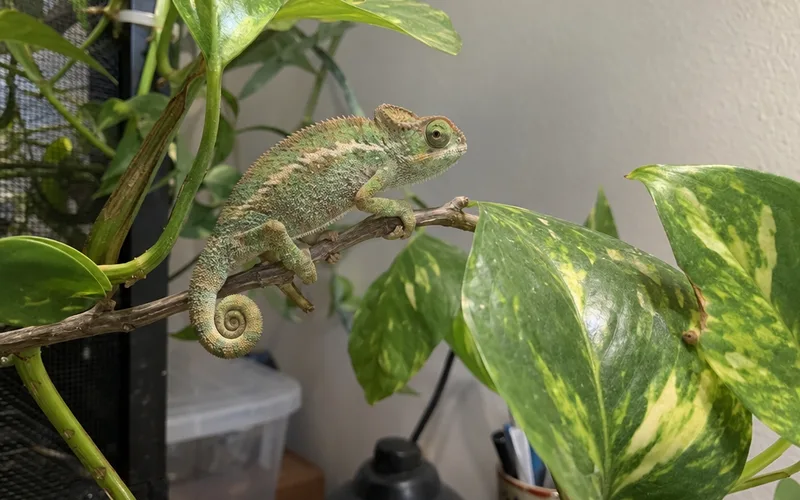
You’ll also hear about locales.
These are color forms named after places in Madagascar, such as Nosy Be, Ambanja, Ambilobe and Sambava. Care is the same for every locale, so choose by the colors you like and the breeder you trust.
Here’s what to ask a breeder before you pay:
- What is the hatch date, and how old will it be when it ships?
- What locale are the parents, and can I see photos of them?
- What insects does it eat now, and how often?
- How do you ship, and what happens if it arrives sick?
A good breeder answers all 4 plainly, and a seller who can’t is a reason to keep looking.
Another honest option is a reptile rescue.
Panther chameleons are frequently given up because their care takes so much time and money, and many rescues and zoos no longer accept them. Adopting an adult or juvenile from a rescue gives one of those animals a second chance.
Key takeaway: Buy or adopt a captive-bred juvenile, and finish the cage before you bring it home.
Step 2: Choose a Tall Enclosure
Panther chameleons are arboreal, which means they live in trees and rarely come down to the ground.
So a panther chameleon habitat needs height first, then width.
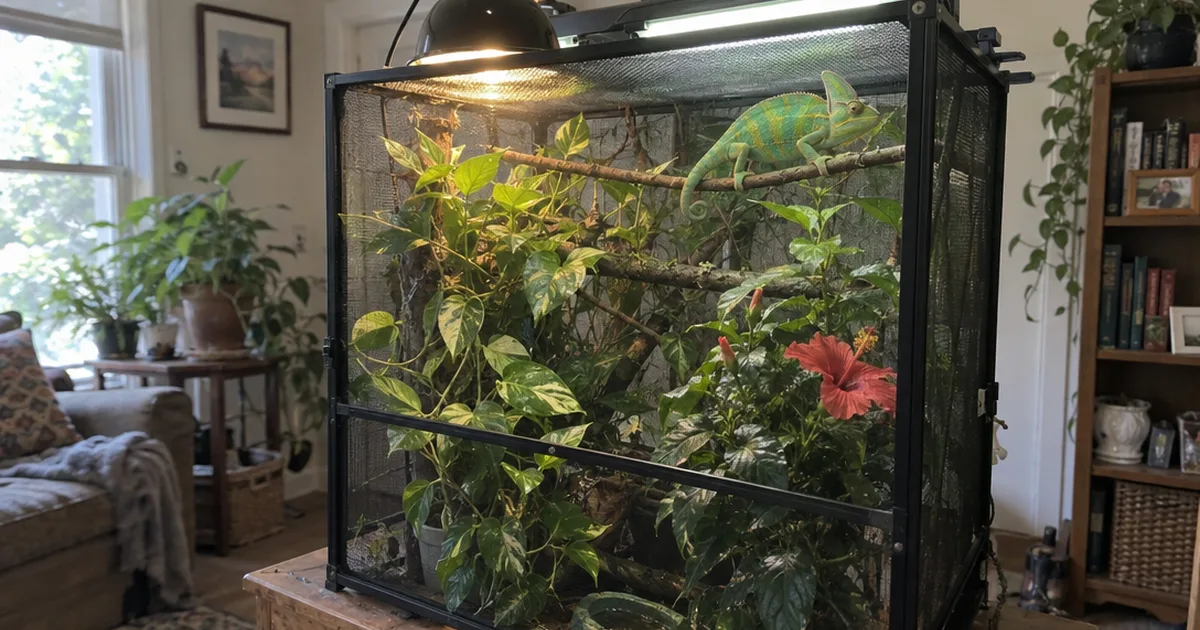
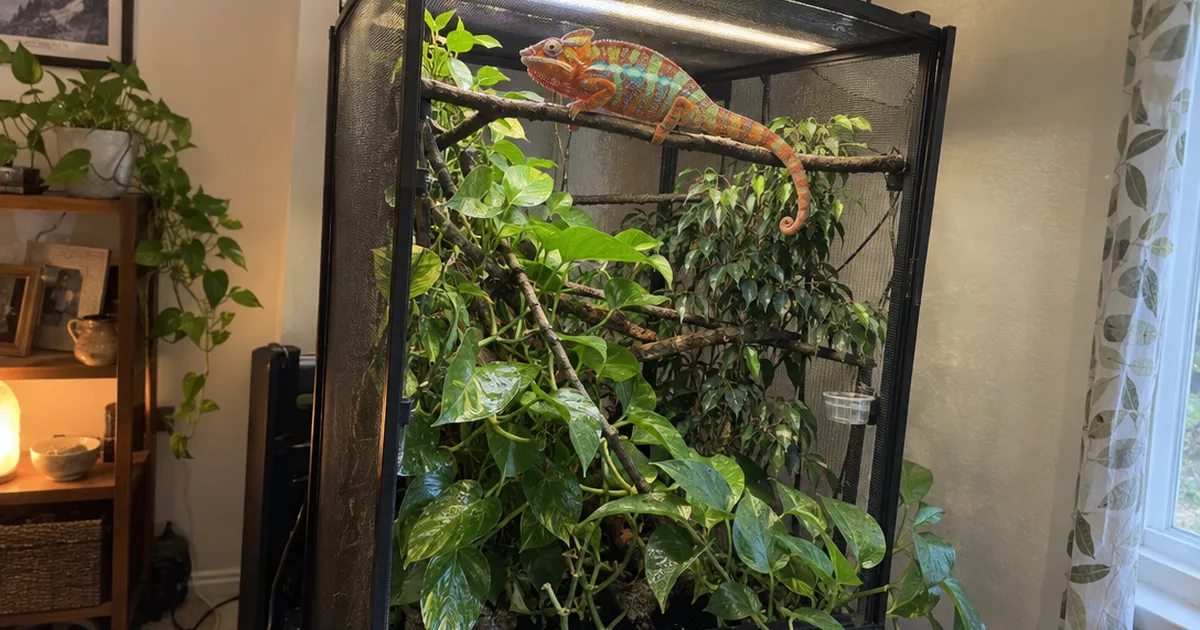
FramsChams, a US panther chameleon breeder, recommends a screen enclosure of at least 24 x 24 x 48 inches for adults in its own care sheet. That 2 x 2 x 4 foot size is the common minimum, and bigger is better.
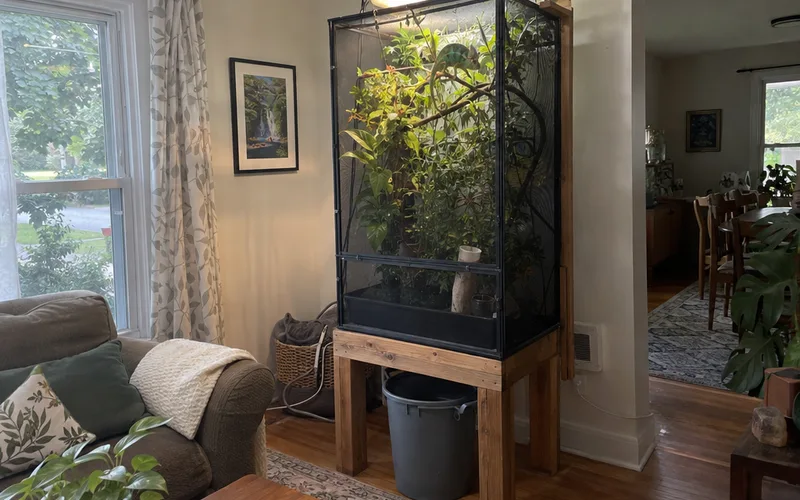
For males, a 36-inch-wide by 24-inch-deep by 48-inch-tall cage gives extra room to move. Females are smaller and can live in an 18 x 18 x 36 inch cage, but the full 2 x 2 x 4 foot cage still gives them a better life for not much more money.
Which cage type should you buy?
It depends on how close your home’s air already is to panther chameleon conditions:
- Screen cage: near 100% ventilation. Best if your room already sits near the right temperature and humidity, day and night.
- Hybrid cage: solid sides with a screen top or front. Best for most homes, because it holds in nighttime humidity.
- Glass or PVC terrarium: the most control. Best in a dry climate, or when you need to hold ambient heat as well as humidity.
You’ll hear that chameleons “must” live in full-mesh cages.
That’s outdated. Screen, hybrid and glass are tools, and the right one is the one that holds your numbers in your room.
In the UK, where homes run colder, Northampton Reptile Centre keeps its panthers in a vented wooden vivarium instead.
If you go with a screen cage in a dry home, cover 2 or 3 sides with opaque plastic or a shower curtain. That holds in humidity and gives your chameleon more privacy, which lowers its stress.
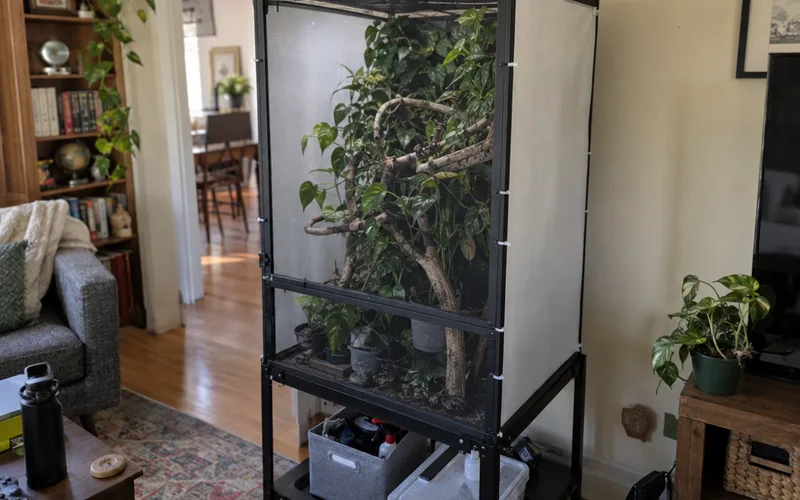
Where you put the cage matters as much as the cage itself.
Chameleons like to look down on the action, so set the cage on a stand that puts the basking branch above your head height. Keep it out of direct window sun, away from heat vents and away from any other chameleon’s line of sight.
If you’re still comparing models, weigh door size, price and how well each one holds humidity in your room before you pick the best chameleon enclosure for you.
Key takeaway: Buy at least a 24 x 24 x 48 inch cage, and pick screen, hybrid or glass by your room’s humidity.
Step 3: Fill the Cage With Branches, Vines and Live Plants
An empty terrarium leaves your chameleon exposed, and an exposed chameleon is a stressed one.
So the goal is a “forest edge” layout, like the sunny border where trees meet open ground: an open basking area at the top and a dense, leafy retreat where your chameleon can hide. The same order of work, from branches to plants to drainage, applies to setting up a chameleon enclosure for any species.
Here’s how to build it:
- Run 2 or 3 horizontal branches across the upper third of the terrarium, with one directly under where the basking lamp will sit.
- Add vertical and diagonal branches of different widths, so your chameleon can climb from the top to the bottom.
- Zip-tie flexible vines through the mesh to link the branches into a network.
- Hang or stand live, non-toxic plants such as pothos and ficus to fill the middle and one side of the cage.
Branch width matters because your chameleon’s feet are built to grip, with toes bundled into two pads.
Mix thin, medium and thick branches, so its feet can stretch and rest in different positions. Slightly springy perches and reptile vines feel softer underfoot than hard dowels.
Avoid cotton rope perches, though.
Long toenails fray the rope, and a loose strand can wrap a toe tight enough that the toe is lost.
Live plants do 3 jobs at once: they give cover, they hold water droplets your chameleon can drink, and they raise humidity as they grow. Artificial plants still give cover, but they don’t help with humidity.

What about the floor?
Most keepers skip a loose substrate, because the heavy water use soaks it fast. FramsChams also says it doesn’t recommend substrate for beginners, since a bare floor is easy to wipe and leaves feeder insects no place to hide.
Instead, drill a drain or set the cage on a stand with a 5-gallon bucket below to catch runoff. If you prefer a covered floor, use newspaper or paper towels, which also let you check your chameleon’s droppings and urates at a glance.
Loose particles carry one more risk.
A chameleon that misses an insect can swallow substrate along with it. A bioactive terrarium, with a living soil layer under the plants, is possible for experienced keepers, but it needs a drainage plan and live soil to stay clean.
Key takeaway: Build a leafy retreat and an open basking branch, and keep the floor bare or drained.
Step 4: Set Up the Basking Lamp and Temperature Gradient
Chameleons can’t make their own body heat, so their metabolism and digestion run on the warmth around them.
They warm up by basking, the way you’d step into a patch of sun on a cold morning, then move to cooler spots once they’re warm.
Here are the temperatures to aim for:
- Basking spot: 85-90°F (29-32°C), measured where your chameleon’s back sits.
- Daytime ambient temperature: the low to high 70s °F, about 72-77°F (22-25°C).
- Night: 60-70°F (15-21°C), with no heat lamp and no light.
A tall terrarium builds this gradient for you.
Heat rises, so the top near the lamp is warmest and the bottom stays coolest. Your chameleon climbs up or down to pick the temperature it needs.
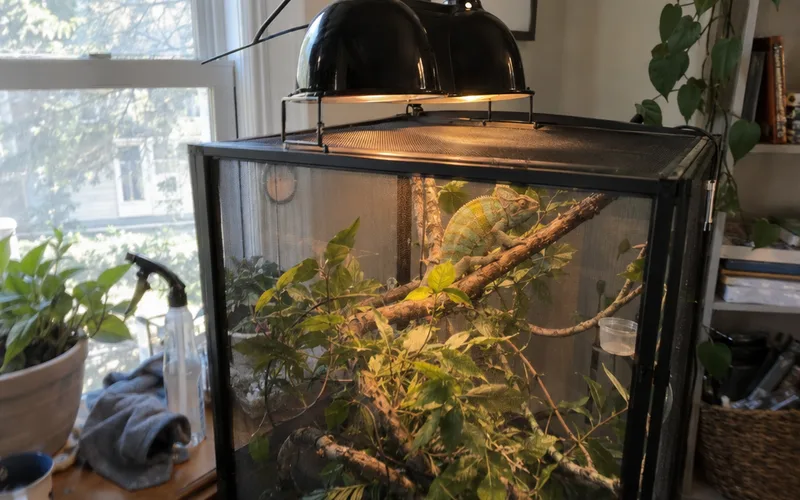
Most setups only need a couple of white 60-watt incandescent heat bulbs, such as the Exo Terra Daytime Heat Lamp.
Two bulbs spread the heat over a wider spot, so your chameleon warms evenly instead of cooking one side. ReptileSupply.com lists the Zoo Med Mini Combo Deep Dome Lamp Fixture at $38.99, a dual-dome fixture rated for up to 100 watts per socket.
Here’s the part that matters most:
Chameleons don’t seem to sense when they’re being burned. They’ll keep basking on a branch that’s too hot until their skin is damaged.
So mount the lamp above the screen, not on it, and keep your chameleon’s back about 6 inches below the mesh. A higher-wattage bulb farther away makes a wider, gentler warm spot than a weak bulb up close.
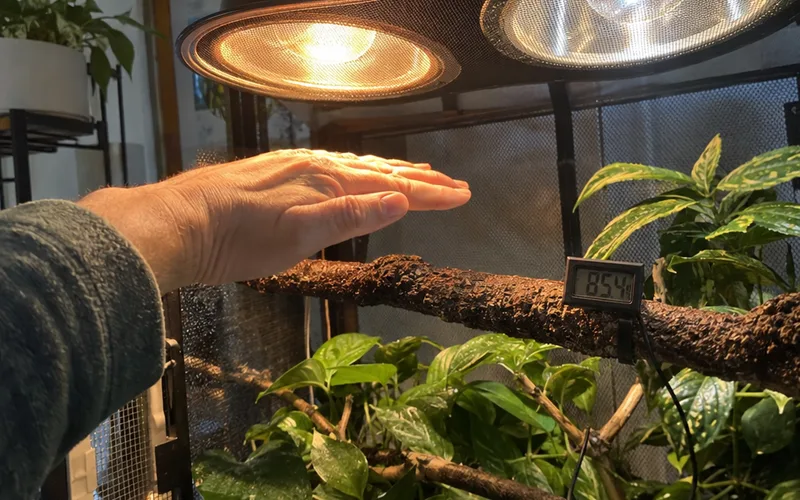
Before your chameleon moves in, hold the back of your hand where its head will be when it basks.
You should feel a warm, pleasant heat after a full minute, not a sting. Then confirm the number with a digital probe thermometer on the basking branch and an infrared thermometer for the rest of the cage.
Watch your chameleon’s behavior after it moves in, too.
Bring the lamp closer, or use a stronger bulb, if your chameleon does any of these:
- Huddles under the bulb for more than 1-2 hours
- Hangs from the top screen right under the lamp
- Stays dark and sluggish instead of brightening into its resting colors after basking
Spotting “too hot” is harder.
The signs are usually physical damage, such as gray burned patches, open wounds or melted-looking crest spines. That’s why it’s safer to start at about 85°F and adjust up.
How long should the basking lamp stay on each day?
Care sheets differ here too. One popular sheet switches the heat lamp off about 4 hours before the other lights, while others leave it on only as long as your chameleon needs to warm up.
In practice, a comfortable chameleon basks for 30 minutes to 2 hours in the morning, then climbs off to hunt. If it needs the lamp much longer than that, warm the whole room or cage a little rather than making the basking spot hotter.
And if the basking spot reads too warm, a plug-in lamp dimmer, a dimming thermostat or a lower-wattage bulb brings it down without moving the fixture.
Turn the basking lamp off at night.
Panther chameleons come from up to about 1,000 meters of elevation, and nights in the 60s °F, or even the high 50s, are normal and healthy. A chameleon only has a problem with cool nights when it can’t warm up properly the next morning.
Key takeaway: Start the basking spot at about 85°F, mount the lamp above the screen and let nights cool down.
Step 5: Add UVB and Bright Daylight Lighting
Panther chameleons are diurnal, active by day, so their lighting sets their whole daily rhythm. Your chameleon needs UVB light to make vitamin D3, and vitamin D3 drives calcium metabolism, letting its body use the calcium in its food.
Without UVB, a chameleon can develop metabolic bone disease, a soft, weak skeleton that leads to deformed legs and fractures.
The most reliable source is a linear T5 HO tube, such as an Arcadia 6% or a Zoo Med ReptiSun 5.0.
Skip compact coil UVB bulbs, because linear tubes are the standard for chameleons.
Why T5 instead of the older T8?
Northampton Reptile Centre, a UK reptile store, says on its care sheet that T5 tubes last about 12 months and reach 18-24 inches. The same store says T8 tubes need replacing about every 6 months and reach only 9-12 inches, which is too short for a 4-foot cage.
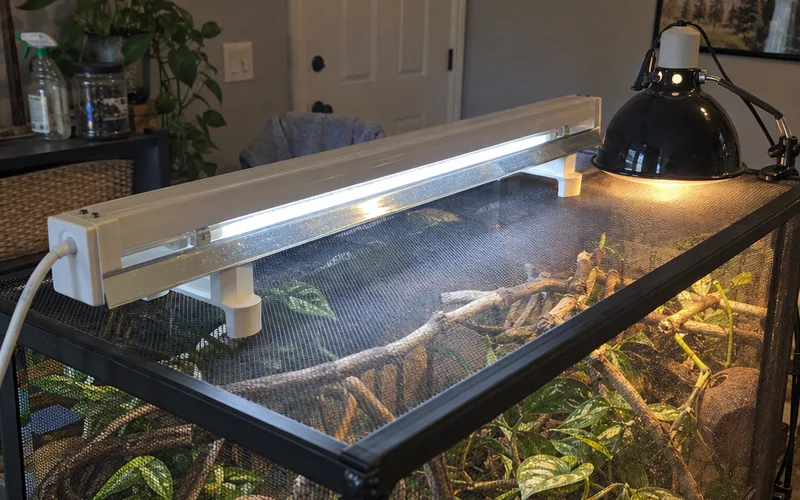
The target is a UV index, or UVI, of about 3 at your chameleon’s back on the basking branch.
UVI is a measure of UVB strength, and most care sheets get there by putting the basking branch about 6 inches below a 6% or 5.0 tube on the screen.
But UVB is strongest right under the bulb.
With a 6% or 5.0 tube sitting on the screen, the top 2-3 inches of the cage get more UVB than you want. A 12% or 10.0 tube creates a danger zone of about 6 inches.
Chameleons often climb upside down across the screen top, exposing their bellies to that zone.
So raise the fixture a few inches above the screen if you can, or keep branches out of the top few inches.
A UVB meter such as the Solarmeter 6.5 takes the guessing out. If you have one, check weekly for the first 2 months and monthly after that, and replace the tube when it can no longer reach about UVI 3 at basking height.
Bulb output fades long before the light looks dim.
A 6% tube starts near UVI 6 and drops to about UVI 2.6 by the end of its life, so a working light isn’t proof of working UVB. Without a meter, follow the maker’s replacement schedule, and some vets advise replacing every UVB bulb every 6 months.
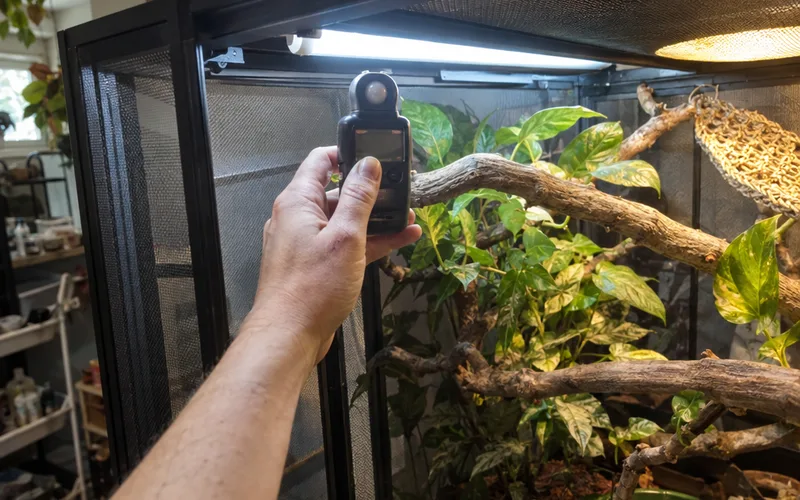
UVB alone isn’t bright enough.
Add a 6500K T5 HO fluorescent or LED daylight bar, such as the Arcadia JungleDawn LED Bar, that spans most of the enclosure top. A dim enclosure looks like a cave with a skylight to your chameleon, and bright light helps live plants grow too.
Run the UVB and daylight on a timer for 12 hours on and 12 hours off. That photoperiod matters, because a chameleon kept under constant light can become stressed and fall ill.
Natural sunlight is excellent, but only unfiltered sun outdoors counts, and a cage in direct sun can overheat. If you take your chameleon outside, use a screen cage in partial shade and stay with it.
Losing UVB is one of the main paths to bone problems, so learn the early signs of MBD in a chameleon now, before you ever need them.
Key takeaway: Use a linear T5 UVB tube for 12 hours a day, aim for about UVI 3 at basking height and replace it on schedule.
Step 6: Build a Humidity and Hydration Routine
This step has the most moving parts, because the numbers change between day and night.
Panther chameleons come from the coastal forests of the north, where days are humid and nights are wetter still.
Humidity is the amount of water vapor in the air, and your chameleon needs it to swing between day and night:
- Day: 40-60% relative humidity
- Night: 80-100% relative humidity
FramsChams recommends 40-50% by day and 80-100% at night on its breeder care sheet. Other care sheets put the day closer to 50-60%, so any number from 40% to 60% in daylight is fine as long as nights run high.
Why the swing?
Chameleons drink some of their water by breathing in moist night air, so humid nights help prevent dehydration. But wet surfaces all day breed bacteria, fungus and mold, and constantly damp branches give feet sores.
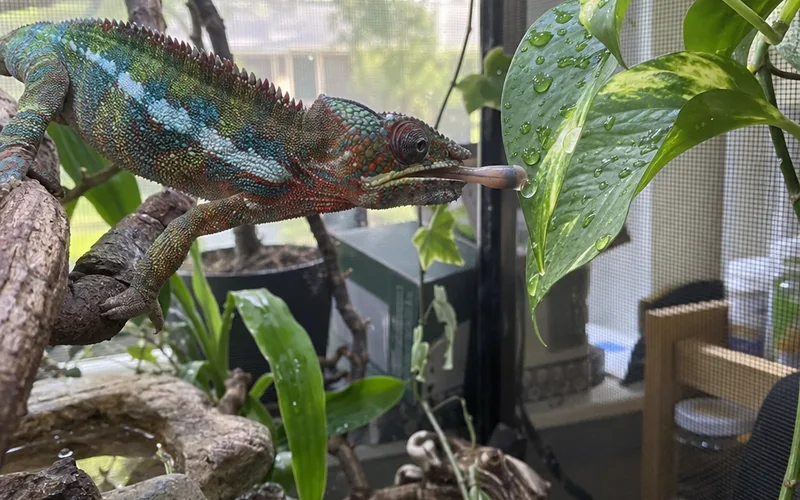
So the 2 rules are simple:
- Keep the air moving, even when humidity is high. Stagnant air, however humid, is linked to respiratory infections.
- Let every surface dry during the day.
Panther chameleons rarely drink from a bowl.
Instead, they lick water droplets off leaves and branches. That’s why misting, dripping and fogging are how you water your chameleon, not just how you raise humidity.
Here’s a sample schedule many keepers start with:
- About 1:30 AM: Mist for a couple of minutes, then run a cool-mist fogger from 1:30 to 6:00 AM, 30 minutes on and 30 off.
- About 6:00 AM, before lights on: Mist again, so your chameleon wakes up to “dew” on every leaf.
- 3:00-5:00 PM: Run a dripper over a plant as a backup water source.
- About 9:00 PM, after lights off: Mist briefly to start the night humidity.
Notice there’s no midday spray.
Chameleons tend not to like being sprayed, and night and early-morning misting lets them drink without a shower in the face. Point the nozzles away from the basking branch just in case.
Put the mister and fogger on timers, and use distilled water.
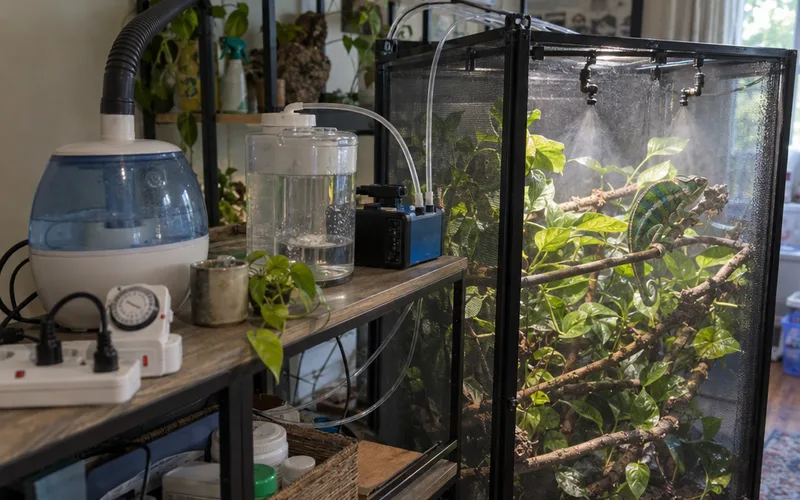
Tap water tends to clog nozzles, and it isn’t good for live plants either. Clean and disinfect your humidifier, mister and dripper weekly, because standing water grows bacteria and mold.
If your enclosure dries out too fast, cover another side of the mesh.
If it stays wet all day, add a small fan or open a side, since day surfaces need to dry.
How do you know your chameleon is drinking enough?
Watch it lick droplets in the morning, and treat the dripper as a backup.
If your chameleon gets enough water from the night fog, morning dew and its food, it will mostly ignore the dripper. A chameleon that drinks from the dripper every day is telling you its routine needs more water.
Key takeaway: Keep days at 40-60%, nights at 80-100%, and let every surface dry before afternoon.
Step 7: Feed Gut-Loaded Live Insects on the Right Schedule
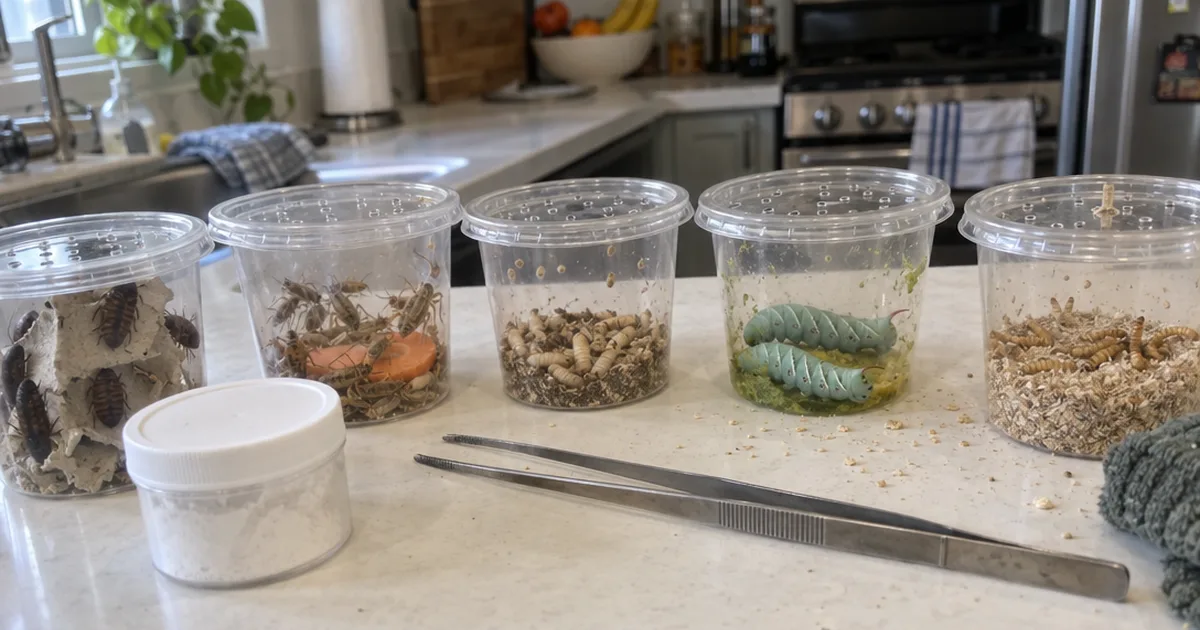
In the wild, panther chameleons eat insects, snails and almost any small prey that fits in their mouth. In captivity they’re fed as insectivores, so they need live insects, and variety is what keeps them healthy.
Good staple feeders include:
- Crickets
- Dubia roaches and other roaches, such as red runners and banana roaches
- Black soldier fly larvae, adult flies and blue bottle flies
- Silkworms
- Hornworms and their adult sphinx moths
- Locusts and stick insects
- Madagascar hissing cockroaches
Use fatty grubs and worms, such as waxworms and superworms, as treats once or twice a week at most.
Some stores offer mealworms only to mature chameleons, 12-18 months or older, because they can be hard to digest. Check how safe mealworms are for a chameleon before you add them, and lean on soft-bodied silkworms as a staple instead.
How much and how often depends on age:
- Babies and juveniles: as much as they can eat, every day.
- Adults: 3-5 appropriately sized insects every other day.
Here’s the catch with adults:
Panther chameleons are enthusiastic eaters, and obesity is common but rarely recognized. In females, extra food means more eggs and larger fat pads around the hips, which can press on the oviduct and lead to egg binding.
So if you keep a female, stick to the adult schedule.
You can feed a visibly gravid female as much as she’ll eat, since her body has already committed to the eggs.
Every feeder should be gut-loaded first.
Gut-loading means feeding the insects nutritious greens and vegetables, such as collard or mustard greens and vitamin A-rich carrots or squash, for 24-48 hours before they become food. Your chameleon’s nutrition is only as good as what its feeders ate.
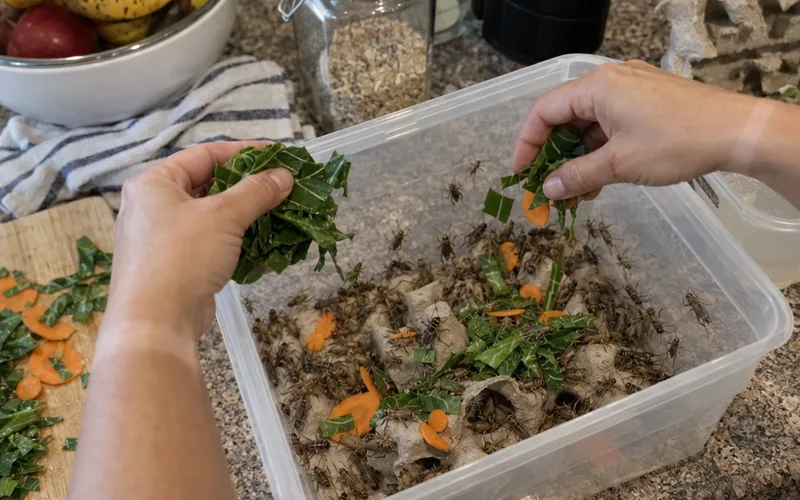
Feed from a cup to cut down on escapes.
A clear, smooth-sided cup clipped to a branch keeps insects in one place, and your chameleon’s tongue reaches right in to grab its prey. It also lets you count what’s been eaten.
One caution:
A chameleon’s tongue extends roughly 2.5 times its body length. If it strikes a glass or plastic wall instead of the insect, it can injure its tongue, so place the cup where a missed shot lands on leaves, not on a hard side.
Most of these feeders suit other species too, so the feeders pet chameleons eat across species are a good way to add variety.
Key takeaway: Feed babies daily and adults 3-5 gut-loaded insects every other day, and keep females lean.
Step 8: Dust Feeders With the Right Supplements
Even well gut-loaded insects can’t supply all the nutrition your chameleon needs.
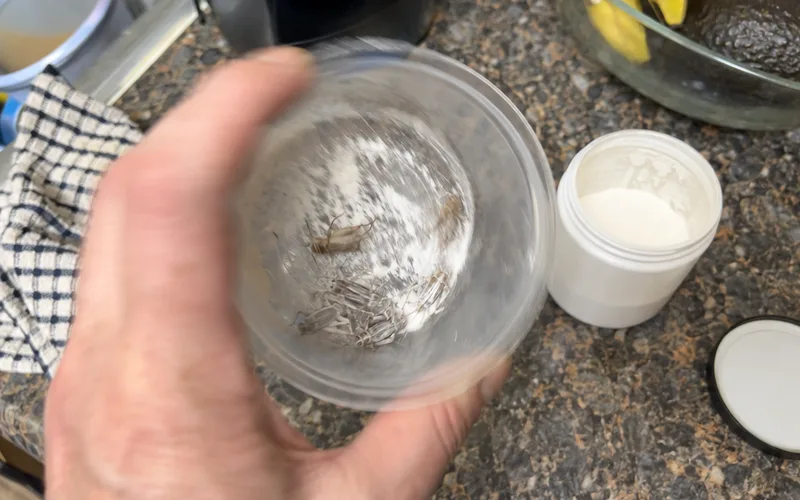
So you lightly dust feeders with powder supplements before each meal.
Chameleons are extra sensitive to the vitamins and minerals in their diet, though, so the goal is a light, regular schedule, not more powder.
Here’s a common schedule:
- Every feeding: a phosphorus-free calcium supplement without D3.
- Twice a month: a multivitamin, or a calcium plus multivitamin powder with a low dose of D3.
The FramsChams care sheet uses this approach, with a multivitamin such as Repashy Lo-D twice a month and calcium without D3 at every feeding.
Why so little vitamin D3?
With good UVB, your chameleon makes its own vitamin D3. That’s why most schedules keep powdered D3 low, and why your supplement schedule depends on your UVB.
If you’re not sure your UVB is strong enough, a calcium powder with some D3 is the safer choice until you can check the tube with a meter or replace it.
Dust lightly.
Shake the insects in a cup or bag with a pinch of powder until they look lightly coated, like powdered sugar on a donut, not caked white.
Care sheets don’t all agree here.
One exotic animal hospital’s care sheet, for example, calls for calcium 3-4 times a week and a multivitamin once a week. If you’re unsure, take your supplement labels to your reptile vet at the first checkup and set the schedule together.
Key takeaway: Use calcium without D3 at every feeding and a multivitamin about twice a month, and match D3 to your UVB.
Step 9: Keep Handling Short and Watch for Health Problems
Panther chameleons are display animals more than hands-on pets.
Most tolerate handling poorly, and some are downright aggressive, so plan to watch far more than you hold.
When your chameleon first arrives, leave it alone for 1-2 weeks so it can settle in.
Feed it, mist it and check its temperatures, but don’t pick it up. If it still hasn’t eaten by the end of those 2 weeks, don’t handle it, and book an experienced reptile vet.
Once it’s settled, you can build trust with food:
- Offer insects from feeding tongs, so it links you with food.
- Once it takes food from tongs, hold your hand or a branch in front of the open cage door and let it walk on.
- Let it walk from one hand to the other instead of gripping it.
Never pull a chameleon off a branch.
Its grip is strong, and pulling can injure its feet or legs. Instead, slide your fingers under its front feet until it grasps you, then lift slowly while you unwind the tail with your other hand.
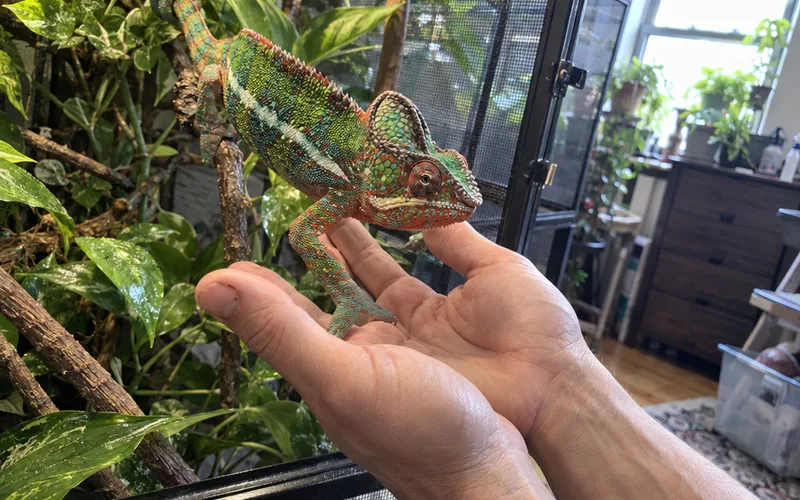
Be gentle with the tail. Chameleons can’t drop their tails like some lizards, and a broken tail won’t grow back.
Panthers also have a painful bite, and a moving finger can look like food, so keep your movements slow and deliberate.
Health checks belong in your daily routine too.
FramsChams advises watching for weight loss, lethargy and color changes, and booking a yearly checkup with a vet who knows chameleons.
Here’s what to watch for:
- Weight loss, lethargy or staying dark: general signs your chameleon is sick or stressed.
- Not eating after its first 2 weeks home: a reason to book a vet.
- Gray patches, open sores or melted-looking crest spines: heat or UVB burns.
- Bent or fractured legs and odd movement: possible metabolic bone disease.
- Labored breathing in a stuffy cage: possible respiratory infection, which stagnant air makes more likely.
- A gravid female who can’t pass her eggs: possible egg binding, which can kill her.
Stuck shed on the toes or tail tip is worth checking too, and the causes and fixes for stuck shed in reptiles apply to chameleons as well.
Find your vet before you need one.
Spotify’s listing for the Panther Chameleon Podcast describes an episode with Dr. Tom Greek pointing out that chameleon-experienced vets are still rare, so it’s smart to find one early. Search the Association of Reptile and Amphibian Veterinarians’ “Find a Vet” directory for your zip code, and call to ask whether the vet sees chameleons.
Here’s what to say: “I have a juvenile panther chameleon. Do your vets treat chameleons, and can I book a wellness exam in the first month?”
I’m not a vet, and nothing here replaces one.
Any of these signs means a call to your reptile vet that day, with photos of the cage and a list of your temperatures, humidity and supplements.
Key takeaway: Handle rarely and gently, check your chameleon daily and line up a chameleon vet before you need one.
What You Need for a Panther Chameleon Setup
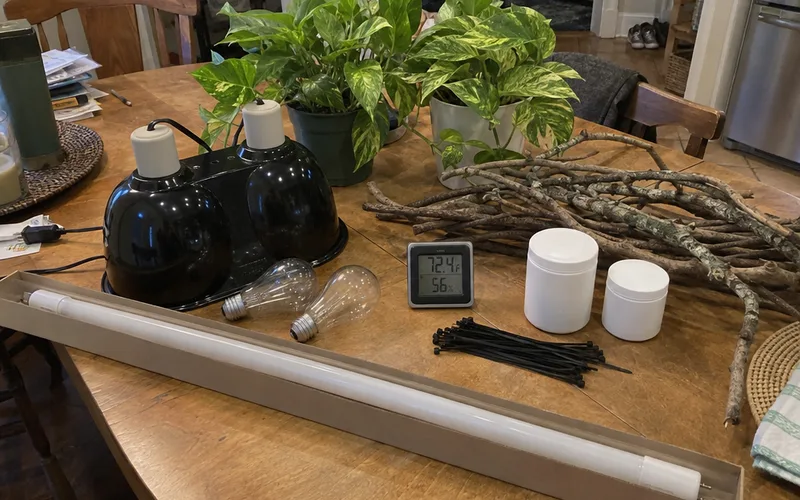
A panther chameleon setup needs a 24 x 24 x 48 inch cage, a basking lamp, a linear T5 UVB tube, a daylight bar, a mister, dripper and fogger, gauges, branches, live plants, live feeders and calcium.
Buy everything on that list before your chameleon arrives, then run the full setup on its timers for 3 days, so you can fix temperatures and humidity without a stressed animal inside.
Enclosure
A 24 x 24 x 48 inch screen or hybrid cage is the starting point, or a 36 x 24 x 48 inch cage for a male.
Add a stand that lifts the basking branch above head height, plus opaque sheeting for 2 or 3 sides if your home is dry.
Heat and Light
You need a dome fixture with two 60-watt incandescent heat bulbs, a linear T5 HO UVB fixture with a 6% or 5.0 tube, and a 6500K daylight bar.
Put them all on a timer or power center, so the lights keep the same 12-hour schedule every day.
Water
Plan for an automatic misting system such as an Exo Terra mister or MistKing, a dripper such as Zoo Med’s The Big Dripper, and a cool-mist fogger or humidifier.
Use distilled water in all 3, and keep a bucket or drain under the cage to catch runoff.
Decor
Gather branches in a few widths, vines, zip ties, and live pothos or ficus in pots.
Artificial foliage can fill gaps while live plants grow in.
Monitoring
Use a digital thermometer and hygrometer with probes at basking height and mid-cage, plus an infrared thermometer for spot checks.
A UVB meter is optional, but it’s the only way to know your tube’s real output.
Food and Supplements
Stock 2 or 3 kinds of live feeders, gut-load food, calcium without D3 and a reptile multivitamin.
A feeding cup and a pair of soft-tipped tongs round out the kit.
What Is a Panther Chameleon?
A panther chameleon (Furcifer pardalis) is a tree-dwelling lizard from the coastal lowlands and islands of northern Madagascar, and one of the largest and most colorful chameleons kept as a pet.
Adults reach about 15-20 inches long, including the tail, and the species shows strong sexual dimorphism: males are much larger than females.
Males also carry the bright colors, in reds, oranges, greens, blues and even rainbow mixes, while females stay a peach, pink or orange color most of their lives.
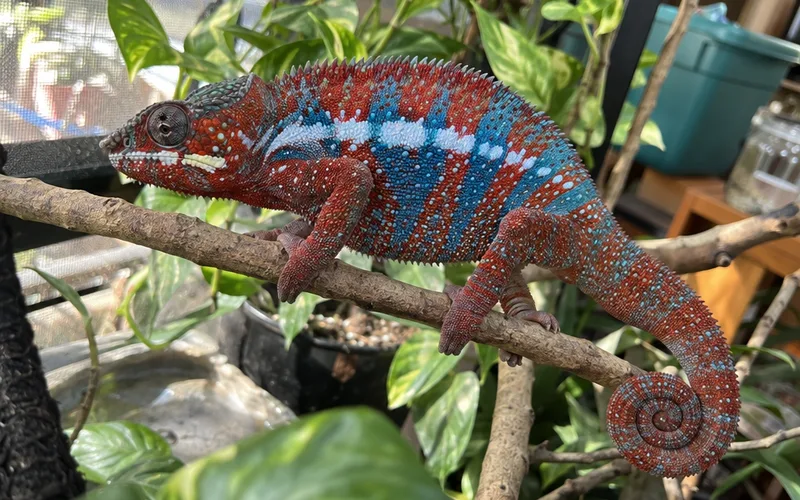
That color depends on the locale, the place a chameleon’s ancestors came from.
Breeders usually keep each locale separate to preserve its color pattern, which is why you’ll see listings named after towns and islands such as Nosy Be, Ambanja and Ambilobe.
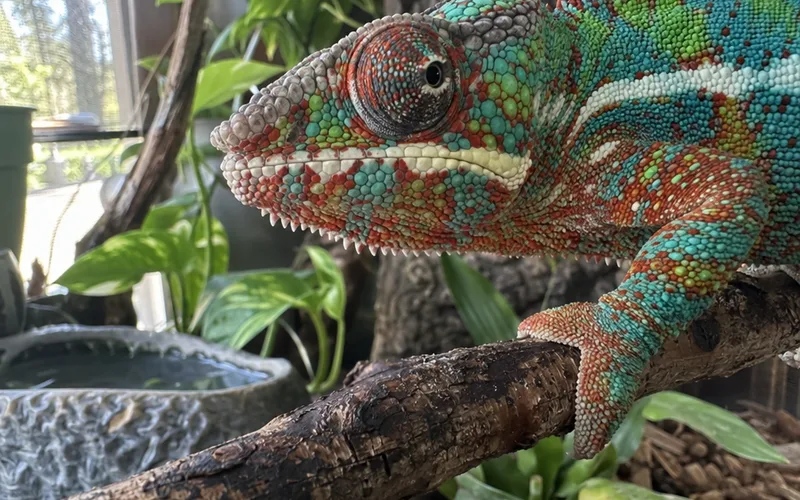
A panther chameleon’s body is built for life in the trees:
- Feet with toes bundled into 2 pads that grip branches like tongs
- A prehensile tail that wraps around branches like a fifth leg
- Eyes on turrets that move separately and can look 2 ways at once
- A sticky tongue that shoots out about 2.5 times the length of its body
In the wild, the species is still abundant in dense forest where prey and cover are easy to find, and it’s considered one of the hardiest chameleons you can keep.
That hardiness, plus how many are bred in captivity, is why it’s a common first chameleon.
Do Panther Chameleons Change Colors?
Yes, panther chameleons change colors, and those colors work like a language.
They shift with age, temperature, health and mood, and a male flares his brightest threat patterns when he sees a rival.
A gravid female can turn a deep black with orange stripes.
For you as a keeper, the most useful signal is color after basking.
A chameleon should brighten into a calm resting color once it’s warm. One that stays dark and sluggish may be too cold, stressed or sick, so check your basking temperature first.
Is a Panther Chameleon Hard to Take Care Of?
Yes, a panther chameleon is harder to keep than most popular pet reptiles, because it needs specialized heat, UVB, water and food routines every day.
But it’s also one of the hardiest chameleons, so a prepared beginner can do well.
Here’s what makes it hard:
- It needs a tall, ventilated cage and 3 kinds of lights.
- It drinks from droplets, so someone has to mist or run timers every day.
- It eats live insects, which you’ll need to buy, gut-load and dust.
- It hides illness well, so problems often show late.
And here’s what makes it doable:
Most of the work happens once, during setup. Timers then handle the lights, misting and fogging, which leaves you a short daily check plus feedings every day or two.
So is it a good first reptile?
It can be.
Panther chameleon care for beginners works best when you want to watch an animal more than hold one and you’re ready to set up the cage before you buy. If you want a pet you can handle often, a more hands-on species may suit you better, and the basics of lizard care carry over to most of them.
Panther Chameleon Temperature and Humidity: Why Care Sheets Disagree
Panther chameleon care sheets mostly agree on an 85-90°F basking spot, 60-70°F nights and 80-100% night humidity, but they differ on daytime air, from 72°F to 81°F, and on day humidity, from 40% to 60%. Each sheet was written for a different home, climate and cage type.
Here’s how the common numbers compare:
- Basking: 85-90°F on most US care sheets; one UK store aims for about 90°F.
- Daytime ambient: 72-77°F on one popular sheet, the mid to high 70s on another, and 77-81°F on a vet clinic’s sheet.
- Night temperature: 60-70°F on most sheets, with drops into the high 50s considered safe.
- Day humidity: 40-50% on a breeder’s sheet and 50-60% on others.
- Night humidity: 75-100% or 80-100% on most sheets, while one vet clinic’s sheet gives 90-100% overall.
So which numbers should you start with?
I’d start at an 85°F basking spot, low to mid 70s °F by day, 60s at night, 40-60% humidity by day and 80-100% at night. Those sit inside the range most current care sheets share.
Then adjust to your chameleon’s behavior.
A chameleon that basks for 30 minutes to 2 hours and then moves off into its leaves is comfortable. One that stays under the lamp all day needs a warmer cage overall, not a hotter basking spot.
Climate explains most of the rest.
A keeper in a humid coastal home can run a full screen cage, while one in a dry desert home may need a glass enclosure just to reach 50% by day.
Key takeaway: Start in the middle of the shared ranges, then let your chameleon’s behavior tell you which way to move.
A Daily, Weekly and Monthly Panther Chameleon Care Routine
A panther chameleon care routine has 3 layers: a daily check of temperatures, humidity, drinking, droppings and food, a weekly clean of the misting gear, and a full cage clean about every 4 weeks.
Timers do most of the daily work, so here’s the routine that’s left for you.
Every Day
- Check the basking temperature, the cool zone and the humidity on your gauges.
- Watch your chameleon drink or look for licked droplets in the morning.
- Feed babies and juveniles, or check whether it’s an adult feeding day.
- Remove droppings, dead insects and wet paper.
- Look over your chameleon’s eyes, skin, feet and urates.
Every Week
- Clean and disinfect the mister nozzles, dripper and fogger tank.
- Wipe the enclosure floor and drain tray.
- Trim plants that block the basking spot or UVB.
- Restock feeders and refresh their gut-load food.
Every Month
- Do a full clean of the terrarium about every 4 weeks.
- Weigh your chameleon on a kitchen scale and note the number.
- Check UVB with a meter, or mark the date to replace the tube.
- Test that every timer still switches on and off on time.
For the full clean, move your chameleon to a safe temporary cage first.
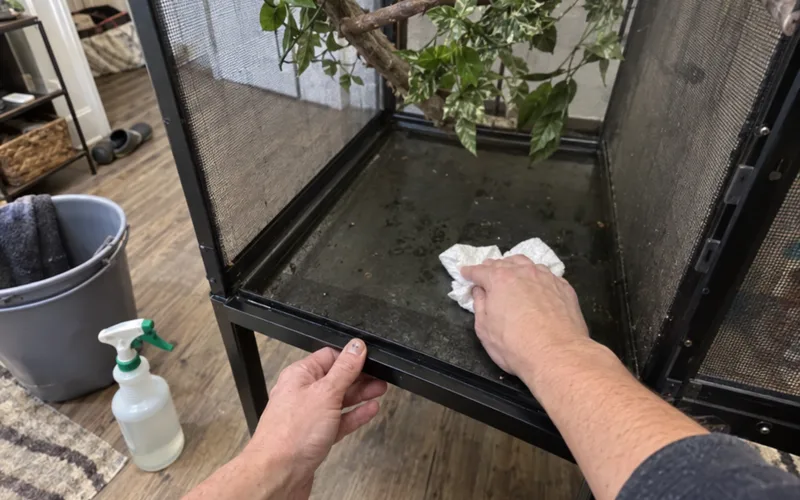
Then take out the plants and decor, spray every surface with a reptile-safe disinfectant, wipe it off after the contact time on the label and rinse the decor well. Do it in the morning, so your chameleon goes back into a warm cage for at least an hour before the lights go off.
Key takeaway: A quick daily check and a monthly deep clean catch most problems early.
How to Care for a Baby Panther Chameleon
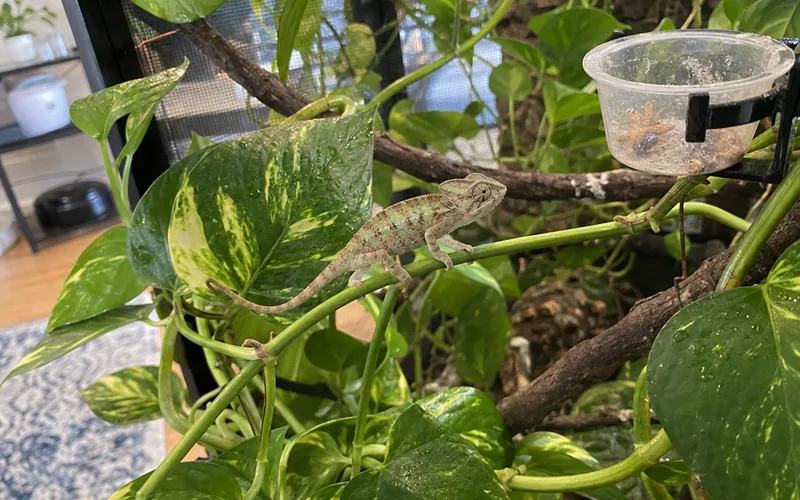
A baby panther chameleon needs the same heat, UVB and humidity as an adult, but it eats every day, needs water droplets at least twice a day and takes smaller insects.
The job of a baby is to grow, so you feed it as much as it will eat every day.
Start with tiny feeders, such as pinhead crickets or small black soldier fly larvae.
Small insects escape easily, so a feeding cup helps, but some babies won’t use one. Count what goes in and check for leftovers, so you know how much your baby really ate.
Water matters even more for a baby.
Your night fog and early-morning mist cover most of that water, so they’re the backbone of a baby’s routine.
You can raise a baby in the adult cage.
Just add extra plants and branches at first, so it can always find cover and food, then thin them out as it grows.
How long can a baby go without eating?
Don’t wait to find out. A baby should eat every day, so even 1 or 2 skipped days in a row means checking heat, UVB and hydration right away, and calling a vet if it still won’t eat.
Supplement the same way as for an adult, with light calcium dusting at every feeding.
Babies grow bones fast, so strong UVB is non-negotiable.
Key takeaway: Feed a baby daily, mist it at least twice a day and give it extra cover in a full-size cage.
How Long Do Panther Chameleons Live?
Most care sheets give male panther chameleons up to about 6 years and females up to about 3 years in captivity.
Some stores list longer averages, so treat those figures as typical ranges, not limits.
Females face an extra risk: overfeeding builds more eggs and bigger fat pads, which can lead to egg binding.
That’s the biggest reason to keep a female on 3-5 insects every other day, and to give her a nesting box of damp soil if she becomes gravid.
Good care pushes your chameleon toward the top of its range:
- Strong, regularly replaced UVB
- Lean, varied, gut-loaded meals
- Day-dry and night-humid conditions
- A quiet cage with no other chameleon in view
Diet, UVB and egg-laying all shape how long panther chameleons live, so the habits that keep yours healthy now also add time later.
What to Do When a Female Panther Chameleon Is Gravid
A gravid female panther chameleon, meaning one carrying eggs, needs more food, a soil-filled nesting box big enough to turn around in, and quiet until she lays.
The clearest sign is color: a gravid female can turn a deep black with orange stripes, which is very different from her usual peach or pink.
Here’s what changes once you see those signs:
- Feed her more. Once she’s clearly gravid, you can offer as much as she’ll eat, since her body has already built the eggs.
- Give her a nesting box. It should be big enough for her to turn around inside it, filled with a soil mix damp enough to hold its shape but not so wet it soaks the eggs.
- Leave her alone. Keep the room quiet and resist checking on her every hour while she digs and lays.
Northampton Reptile Centre uses this kind of soil-filled box for its own gravid females.
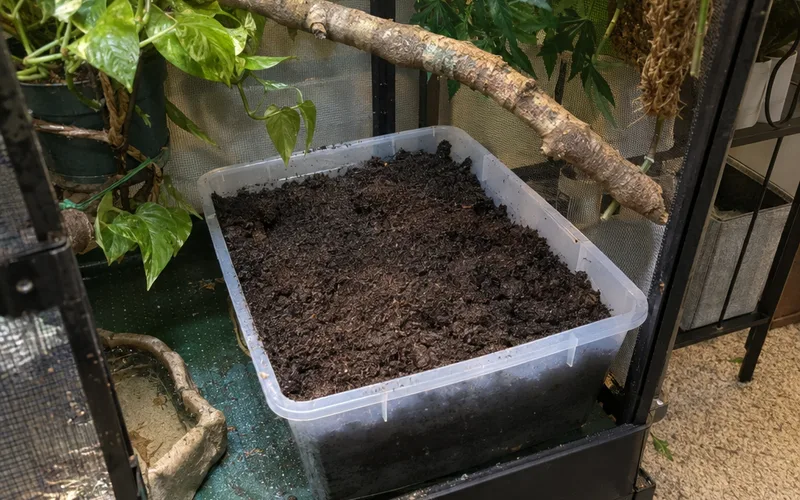
Watch the timing closely, because egg binding is the real danger.
If she seems to struggle, looks weak, or stays heavy without laying, call your reptile vet the same day.
What about the eggs?
For keepers who breed, the same store incubates its eggs at 84°F in sealed boxes on a moisture-holding substrate, and they start to hatch after about 9 months. That’s a long commitment, so decide before you ever house a male and female near each other.
Should You Buy a Panther Chameleon Egg?
Some sellers offer panther chameleon eggs for less than a hatchling.
But cheap isn’t a good reason to start there. Hatching an egg means months of steady incubation and then hatchling care, and the Panther Chameleon Podcast devotes a full episode to the pros and cons before anyone buys one.
For a first chameleon, a well-started juvenile is the easier and safer path.
Common Panther Chameleon Care Mistakes
The most common panther chameleon care mistakes are a basking lamp resting on the screen, two chameleons in one cage, uncovered glass, a water bowl as the only water, overfeeding adults, old UVB tubes and surfaces left wet all day.
Each one is easy to fix once you know it.
Putting the Lamp on the Screen
A basking bulb resting on the screen top can burn a chameleon that climbs right up to it.
Raise it above the mesh and keep the basking branch about 6 inches below.
Keeping Two Chameleons Together
You’ll hear stories of pairs, brothers or females who “get along.”
There’s no setup that’s good for both chameleons, so the rule is one chameleon per cage.
Panther chameleons are solitary and territorial, and a male in constant sight of another male can stress himself into illness. Keep cages far enough apart, or block their view, so neighbors can’t see each other.
Using a Glass Tank Without Covering It
Glass reflects, and a male can see his reflection as a rival.
If you must use glass for a sick or very young chameleon, cover 3 sides and the top with paper or a towel.
Relying on a Water Bowl
A bowl alone can leave your chameleon dehydrated, because most chameleons won’t drink standing water.
Use misting, a dripper and live plants instead, so droplets form on leaves every night and morning.
Overfeeding Adults
Free-feeding an adult leads to obesity, and in females, to egg binding.
Switch to 3-5 insects every other day once your chameleon reaches adult size.
Keeping Old UVB Tubes
A UVB tube that still glows may no longer produce useful UVB.
Track its install date and replace it on schedule, or test it with a UVB meter.
Keeping Surfaces Wet All Day
Daytime misting can leave branches and leaves damp until dark.
That’s how foot sores and mold start, so let surfaces dry by afternoon.
Key takeaway: Fix lamp height, housing and day humidity first, because each one leads straight to burns, stress or sores.
Panther Chameleon vs Veiled Chameleon Care
Panther chameleon care and veiled chameleon care share the same basics: a tall cage, a basking spot, UVB, a misting routine and live insects. The clearest difference is appetite, since panthers are enthusiastic eaters but not as ravenous as veiled chameleons.
Both species can become overweight, so both need lean, measured feeding once they’re adults.
If you’re still deciding between the 2, compare the daily routine for veiled chameleons side by side with this one.
The basics of chameleon care are the same for every species people keep, so the setup you build now is the right foundation either way.
Frequently Asked Questions
Is it hard to take care of a panther chameleon?
Panther chameleons are harder to keep than most popular pet reptiles because they need a tall cage, UVB, a basking lamp, a misting routine and live insects every day or two. They are also one of the hardiest chameleons, so a beginner who builds the setup first and sticks to the schedule can do well.
How long do panther chameleons live?
Most panther chameleon care sheets give males up to about 6 years and females up to about 3 years, and some stores list longer averages. Strong UVB, lean meals and a quiet cage of its own give a chameleon its best chance at the top of that range.
What is the ideal basking temperature for a panther chameleon?
The ideal basking temperature for a panther chameleon is 85-90°F, measured at the spot where its back sits under the lamp. Start at the low end, about 85°F, and raise it only if your chameleon stays dark or huddles under the bulb for more than 1-2 hours.
How do I care for a baby panther chameleon?
A baby panther chameleon needs the same heat, UVB and humidity as an adult, plus daily feedings of as many small insects as it will eat and water droplets at least twice a day. Use small feeders, such as pinhead crickets, and add extra foliage so a small chameleon can find its food and hide.
How many days can a baby chameleon go without eating?
A baby panther chameleon should eat every day, so even one or two skipped days in a row is a reason to check its heat, UVB and hydration. If a newly arrived chameleon still has not eaten after its first 2 weeks of settling in, book an experienced reptile vet.
Do panther chameleons change colors?
Panther chameleons change colors with age, temperature, health and mood, and their colors work like a language. Males show the brightest colors, which depend on their locale, and a chameleon that stays dark after basking may be cold or stressed.
Can two panther chameleons live together?
No, two panther chameleons should not share a cage, because they are solitary and territorial. Males stress themselves to the point of illness in sight of another male, so give each chameleon its own enclosure and block their view of each other.
Can you handle a panther chameleon?
You can handle a panther chameleon briefly, but most tolerate it poorly, and handling is stressful for them. Let it walk onto your hand on its own, support its body, never pull it off a branch, and keep sessions short.
How much does a panther chameleon setup cost?
The one verified price in this guide is the Zoo Med Mini Combo Deep Dome Lamp Fixture at $38.99 on ReptileSupply.com, and the cage, UVB, misting system, plants and feeders add more on top. Price every item on the shopping list in this guide at one store before you buy the chameleon.
Where should I buy a panther chameleon?
Buy a captive-bred juvenile from a reputable breeder, or adopt from a reptile rescue, rather than a wild-caught adult. Ask the seller the animal’s hatch date, locale and what it eats, and finish your setup before it ships.
Final Thoughts
Panther chameleon care comes down to one idea: build the cage, heat, UVB and water routine first, then add the chameleon.
This week, write your shopping list from Step 2 through Step 6 and run the empty setup on its timers for 3 days before your chameleon comes home.