A baby tegu fits in the palm of your hand, but it won’t stay that way for long. As breeder Cindy Troost-Massolin puts it in Reptiles Magazine, “They remain cute, but they don’t remain little.”
In this guide, you’ll see tegus size broken down by sex, species and life stage, why published numbers disagree, and what an adult’s size means for its enclosure, heat and handling.
Let’s dive right in.
How Big Do Tegus Get?
Most adult tegus kept as pets end up between 3 and 5 feet long. Pisces Pets, a pet store that sells reptile supplies, describes tegus as lizards that “grow an astounding 3-5 feet in length.”
That range covers the common pet species, but the biggest numbers come from one tegu in particular. The Australian Reptile Park, a zoo that houses the Argentine black and white tegu, calls it “the largest of the tegu lizards.”
Here’s the deal: length alone hides how heavy these lizards get. Troost-Massolin writes that Argentine tegus “can grow upward of 5 feet long and weigh more than 20 pounds,” which makes a big adult a two-handed lift.
So when you ask how big a tegu gets, the honest answer is plan for a 4-foot lizard and be ready for a 5-footer. The rest of this guide breaks that range down so you can see where your own tegu is likely to land.
Male vs. Female Tegu Size
Males are the bigger sex, and the gap is easy to see in the numbers. According to the Australian Reptile Park, males “can grow to between 1.2m - 1.35m length while the females grow to just over 1m.”
In feet, that works out to about 3.9 to 4.4 feet for males and a little over 3.3 feet for females. Reptiles Magazine lands in a similar place, with average males at 4 to 4.5 feet and average females at 3 to 3.5 feet.
Males also look different as they mature. Pisces Pets notes that male tegus develop large jowls as adults, except in the gold tegu, so a broad, heavy head is usually your first clue that you have a male.
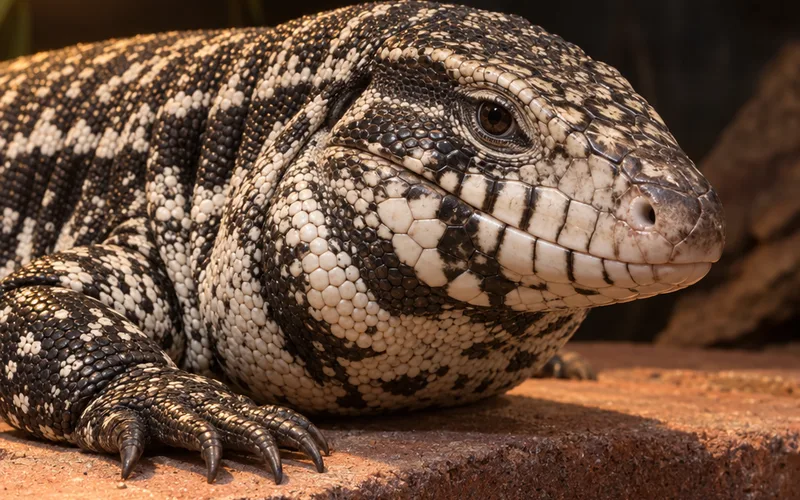
That difference should shape your plans early. If you’re buying a young male, size your future enclosure for the top of the range rather than the middle.
Tegus Size and Weight: What an Adult Weighs
Weight is where tegus surprise people, because a long lizard is also a heavy one. Troost-Massolin reports in Reptiles Magazine that an average female is “around 3 to 3½ feet long and 6- to 8-plus pounds,” while an average male is “about 4 to 4½ feet long and 8- to 12-plus pounds.”
Here’s how those figures line up side by side:
- Average female: 3 to 3.5 feet, 6 to 8+ pounds
- Average male: 4 to 4.5 feet, 8 to 12+ pounds
- Large adults: over 5 feet and more than 20 pounds
The breeder is also clear that these are averages, not limits. In her words, “There are always exceptions to the rule, however, including tegus that are smaller and larger than the average.”
Why does weight matter for you?
Because a 10- to 20-pound lizard can tip light bowls, shove decor around and dig through loose setups. Troost-Massolin uses heavy ceramic food and water bowls for exactly that reason, so her tegus can’t flip them and swallow substrate.
Note: a heavier tegu isn’t automatically a healthier one. Reptiles Magazine warns that because tegus will eat all sorts of food, “obesity can occur,” so weight should rise along with length, not race ahead of it.
Which Tegu Gets the Biggest?
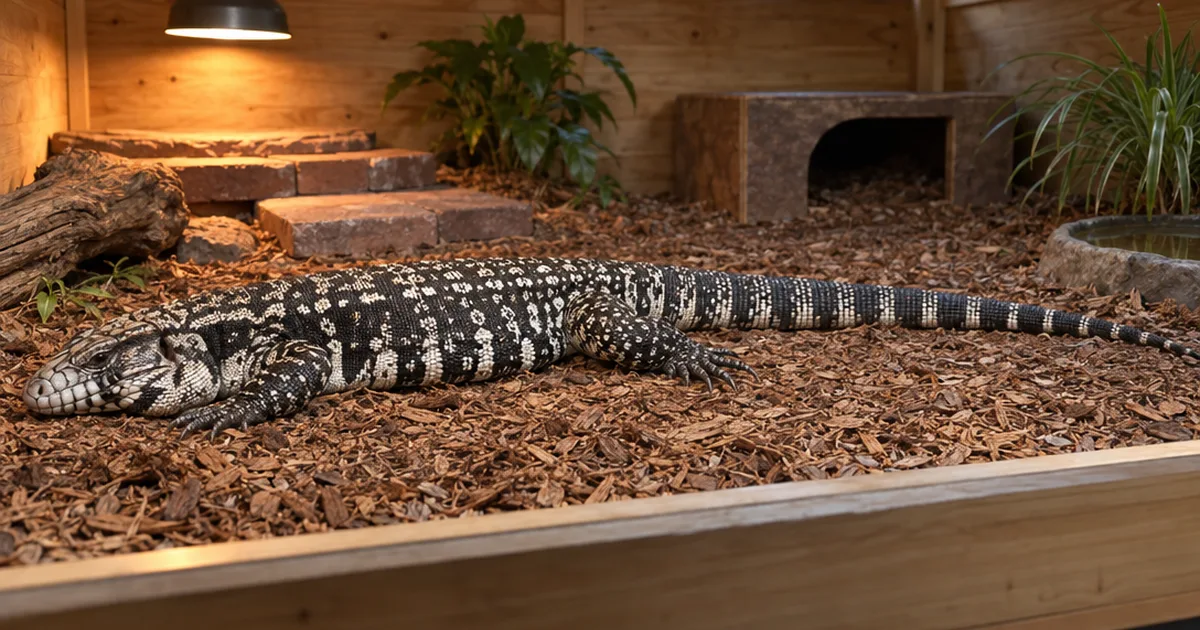
The Argentine black and white tegu, known to scientists as Salvator merianae, is the biggest tegu you’re likely to see for sale. The Australian Reptile Park describes it as the largest of the tegu lizards, and the biggest figures in every source reviewed here come from this species.
Its wild home is South America. The zoo lists forests in Paraguay, Argentina, Brazil and Bolivia, and Reptiles Magazine adds Uruguay and meadows of pampas grass.
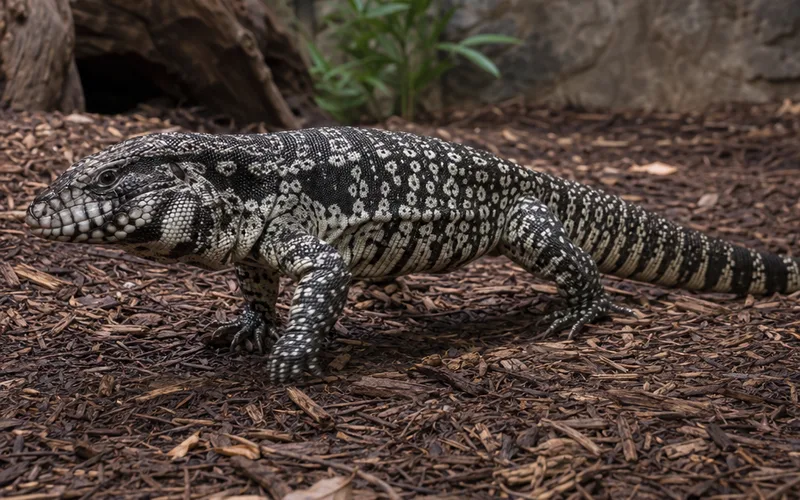
Tegus as a group belong to the lizard family Teiidae and come from Central and South America, according to Pisces Pets. The store names three species you’ll most often find as pets:
- Argentine black and white tegu: the largest of the three and the source of most size data
- Red tegu: a species Troost-Massolin keeps alongside her Argentines
- Gold (common) tegu: the one species whose males don’t grow big jowls
You’ll also see the genus name Tupinambis on older care sheets and vet handouts. It covers the gold, or Colombian, tegus, which are generally described as smaller than the Argentine black and white.
What about searches for “blue tegus” and “white tegus”? Those names describe color forms you’ll see in breeder listings, and none of the sources measured here gives separate size figures for them.
If you’re buying one of those forms, ask the breeder how big its parents are. Until you know more, plan your housing for a full-size Argentine.
Why Tegu Size Estimates Don’t Match
If you’ve compared care sheets, you’ve probably seen numbers all over the place. One source says 3 to 5 feet, a zoo gives 1.2 to 1.35 meters for males, and a breeder quotes averages by sex.
So who’s right? Mostly, all of them.
The ranges drift for four simple reasons:
- Sex. Males run about a foot longer than females on average, so any range that blends both looks wide.
- Species. A figure for “tegus” may lump the big Argentine in with smaller gold tegus.
- Individual variation. Troost-Massolin stresses that some tegus land below the average and some well above it.
- How length is measured. Most size figures are total length, nose to tail tip, while Pisces Pets uses length without the tail as a feeding milestone.
Units add one more layer of confusion. The zoo’s 1.35 meters equals about 4.4 feet, so convert metric figures before you compare them with ranges given in feet.
That gives you a simple rule: read every size figure as “which sex, which species, measured how?” before you use it to plan a setup.
Tegu Size Chart by Life Stage
Reptiles Magazine sorts tegu care into hatchlings, yearlings, and subadults or adults, and each stage needs a different setup. Here’s what the sources say about each one:
- Hatchling: a 20-gallon tank works for a baby, per Pisces Pets, though Troost-Massolin recommends at least 4 x 2 x 2 feet from the start
- Yearling: still housed in at least 4 x 2 x 2 feet, with a 100-watt mercury vapor bulb overhead
- Subadult: moves into adult housing of at least 8 x 3 x 3 feet
- Adult: 3 to 4.5 feet on average and up to 5+ feet and 20+ pounds, with 8 x 4 x 3 feet as the ideal enclosure
One gap stands out in that chart. None of the sources measured here gives a hatchling’s length in inches, so I won’t guess at one.
Instead, use the setup milestones above and track your own tegu’s numbers as it grows. Those records tell you far more about your animal than any published average.
Baby Tegu Size
Baby Argentine tegus look quite different from adults. The Australian Reptile Park says young tegus have “an emerald green colour from the snout to their back,” and that green fades as they grow until the whole body is black and white.
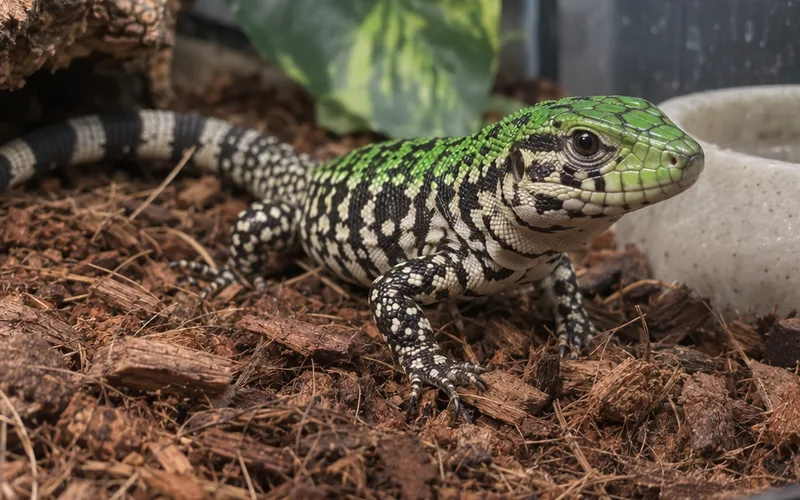
That color change works as a rough marker of age. A tegu that still shows plenty of green is young, with a lot of growing left to do.
Babies also eat often. Pisces Pets says young tegus need feeding multiple times per day until they’re about 6 inches long without the tail, which gives you a size milestone measured from snout to vent rather than to the tail tip.
Juvenile and Yearling Tegus
The juvenile stage goes fast. The zoo’s profile puts it simply: “The juveniles grow up very quickly.”
Troost-Massolin skips the small aquarium entirely at this stage. She recommends an enclosure at least 2 feet tall, 2 feet wide and 4 feet long, with sliding front doors and a top that’s mostly solid to hold heat and humidity.
The best part?
One 4-foot enclosure can carry a tegu from hatchling through its first year. That spares you from buying two or three tanks in a row.
Pro Tip: if you start with a 20-gallon tank like Pisces Pets suggests, budget for the next enclosure right away. A juvenile grows quickly, so that small tank is a short stop rather than a home.
Subadult and Adult Tegus
By the subadult stage, your tegu needs adult housing. Reptiles Magazine treats subadults and adults the same way for enclosure size, hide boxes and lighting, so plan the full-size setup before your tegu is full size.
Adults settle into the ranges covered earlier: roughly 3 to 3.5 feet for females and 4 to 4.5 feet for males. Some heavy-bodied tegus go past 5 feet, which is why the ideal enclosure has extra width as well as length.
How Long Does It Take a Tegu to Reach Full Size?
This is one of the most common questions about tegus, and the honest answer is that the sources here don’t give a firm age. The zoo says juveniles grow very quickly, and Reptiles Magazine moves a tegu from hatchling to yearling to subadult, but nobody puts an exact year on “full size.”
What we do have is one real example. Troost-Massolin describes a black and white tegu she rescued at just 1 pound that, two years later, “now weighs in at just less than 10 pounds.”
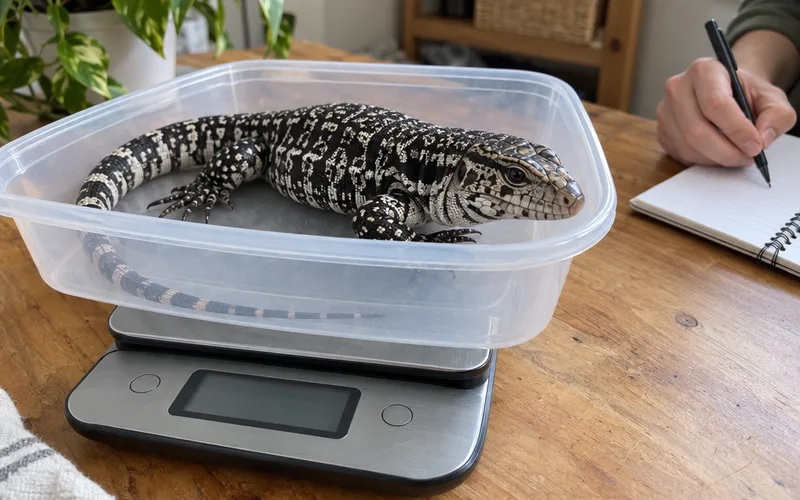
She adds that she can’t know whether his early near-starvation stunted his growth. So treat that story as one tegu’s path, not a growth curve for yours.
Here’s what I’d do instead: weigh your tegu once a month and note its length at the same time. Steady gains that level off as it reaches the adult range tell you more than any calendar can.
Whether reptiles ever truly stop growing is a separate question. For planning purposes, the adult ranges above are the numbers that matter.
What Affects How Big Your Tegu Gets
Species and sex set the range, but care decides whether your tegu reaches it in good health. Three factors come up again and again in the sources: diet, light and heat.
Diet and Feeding Ratios
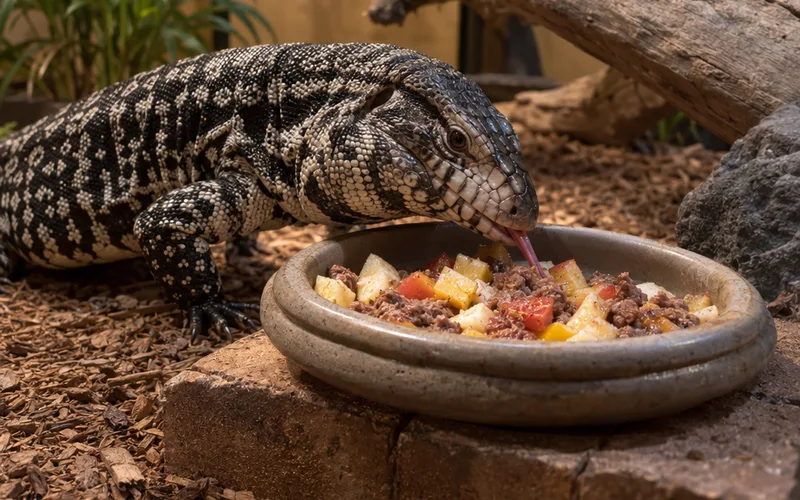
Troost-Massolin shifts the balance of protein to fruit and vegetables as a tegu ages. She suggests about 4:1 for hatchlings, 3:1 for yearlings and roughly 2:1 for subadults and adults.
Her protein list includes ground turkey, chicken, eggs and insects such as crickets and mealworms, plus frozen-thawed pinkies, fuzzies or mice about once a week. Pisces Pets is more cautious with rodents for grown tegus and suggests an appropriately sized mouse as a treat up to twice a month.
Why the difference? These are two keepers’ routines, not a fixed standard.
I recommend using them as starting points and adjusting to your tegu’s body shape, since an animal that eats everything offered can slide into obesity.
UVB, Calcium and Bone Health
A tegu can’t build a strong skeleton without the right light. Reptiles Magazine notes that poor calcium absorption, called nutritional secondary hyperparathyroidism, is a common problem in lizards kept indoors, including tegus.
You’ll more often hear that problem called metabolic bone disease. Pisces Pets says full-spectrum UVB lighting is essential for calcium metabolism, appetite and preventing it.
Both sources also add calcium to the menu. Pisces Pets recommends dusting proteins with a calcium supplement every other feeding, and Troost-Massolin adds calcium with D3 every third or fourth feeding plus a reptile multivitamin.
Heat and Activity
Wild Argentine tegus follow a daily rhythm built around heat. According to Reptiles Magazine, they walk to a basking spot, warm up, hunt, bask again to help digest their meal, and then retreat to a burrow to cool down overnight.
That rhythm is why heat matters for growth, not just comfort. A tegu that can’t warm up properly can’t digest its food well, so the temperature setup later in this guide is part of how it grows.
Enclosure Size for an Adult Tegu
Here’s where tegu size really hits your living space.
Troost-Massolin writes that 3 feet tall, 3 feet wide and 8 feet long “would be the minimum size needed for a subadult or adult.” Make it 4 feet wide instead, and she says it “would be ideal.”
Pisces Pets sets a lower floor of 6 x 3 x 2.5 feet. If you have the room, I recommend going straight to 8 x 4 feet, because a 4.5-foot male is longer than a 3-foot enclosure is wide, and that extra foot gives it room to turn around.
Notice that height barely changes between those recommendations. Tegus are ground-dwelling lizards, so floor space matters far more than height.
That makes tegus a different housing problem from other big lizards. If you’ve looked at iguana enclosure size, don’t assume the same cage will work for a tegu.
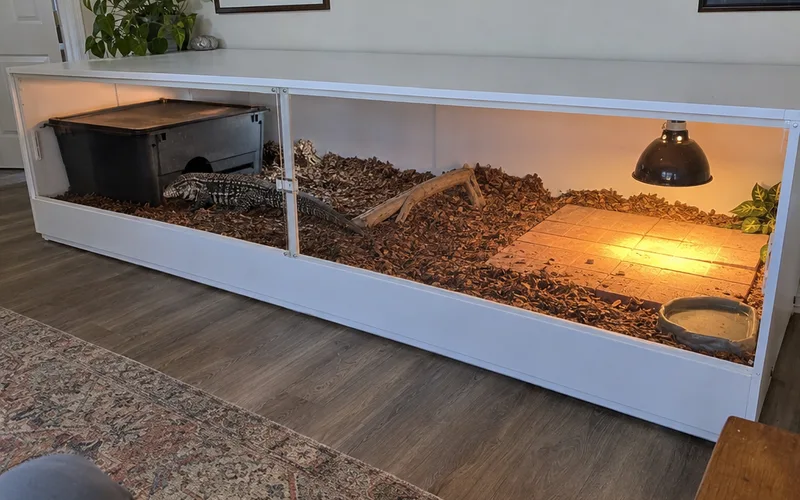
An 8-foot enclosure is a serious build. Troost-Massolin makes hers from half-inch melamine walls with acrylic sliding doors, and DIY enclosure plans can help you sketch one that fits your room.
Depth counts as well as floor space, because tegus dig. Troost-Massolin uses a 6-inch layer of wheat straw in her adult enclosures, while Pisces Pets recommends at least 8 inches of substrate and cypress mulch to hold humidity.
Both sources rule some materials out. Reptiles Magazine says not to use pine or cedar mulch, and Pisces Pets warns against sand because it can be swallowed and cause intestinal blockages.
Security matters more as your tegu gets stronger. Pisces Pets says a heavy weight on the top or a lock is needed to keep a tegu from escaping.
Hide Box Sizes as Your Tegu Grows
A tegu spends about 60 percent of its time in its burrow, according to Troost-Massolin, so its hide box has to grow with it. She uses clear plastic totes in three sizes:
- Hatchling: about 6 x 11 x 16 inches
- Yearling: about 6 to 8 x 16 x 23 inches
- Subadult or adult: about 14 x 19 x 32 inches
She fills each tote about three-quarters full with a damp mix of 65 percent coco husk and 35 percent sphagnum moss. Then she cuts an entry hole 1 to 2 inches wider than the tegu, which you may need to enlarge as it grows.
That moist hide does more than give your tegu privacy. Troost-Massolin ties good shedding and intact toes and tails to the humidity inside it, so keep it damp rather than wet.
Heat and Lighting for a Lizard This Big
Big enclosures need big heat. Reptiles Magazine’s setup uses a 160-watt mercury vapor bulb (MVB) for adults, which supplies both heat and UVB, and a 100-watt MVB for hatchlings and yearlings.
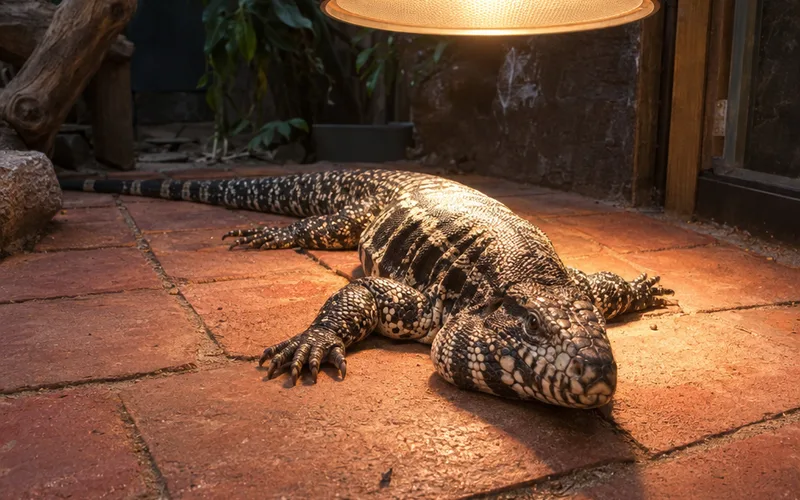
Under that bulb, Troost-Massolin builds a 3 x 3-foot brick patio for basking. The bricks hold heat after the lights go off, wear down sharp nails and lift out one at a time for spot cleaning.
Here are her target temperatures:
- Basking spot: 95 to 105°F, measured about 2 to 4 inches above the bricks
- Warm end: 85 to 95°F
- Cool end: 75 to 85°F
- Night: around 70°F
Pisces Pets gives a similar spread of 75°F at night to 100°F during the day, with a heat bulb at one end so your tegu can move away from the warmth. If you need help setting up and checking that gradient, the basics of terrarium temp apply here too.
Humidity is harder in a big enclosure. Pisces Pets recommends 60 to 90 percent and says a large setup usually needs a fogger or misting system, while Troost-Massolin mists the side walls daily and keeps a moist hide.
All of this fits the broader rules of lizard care: a hot end, a cool end and a damp place to hide. With a tegu, everything is simply scaled up, and you should arrange every lamp so your tegu can’t touch it and burn itself.
Living With a Full-Size Tegu
Size changes how you handle a tegu every single day. Troost-Massolin’s advice is to always support your tegu from its body and never pick it up by the tail.
That matters because adults are strong. The Australian Reptile Park describes strong claws for digging, strong jaws with sharp teeth, and a tail the tegu swings hard when it feels threatened.
The good news? Tegus respond well to patient handling.
Pisces Pets calls them intelligent and curious lizards that can be tamed with regular interaction, and even suggests leash walks once a tegu is fully grown.
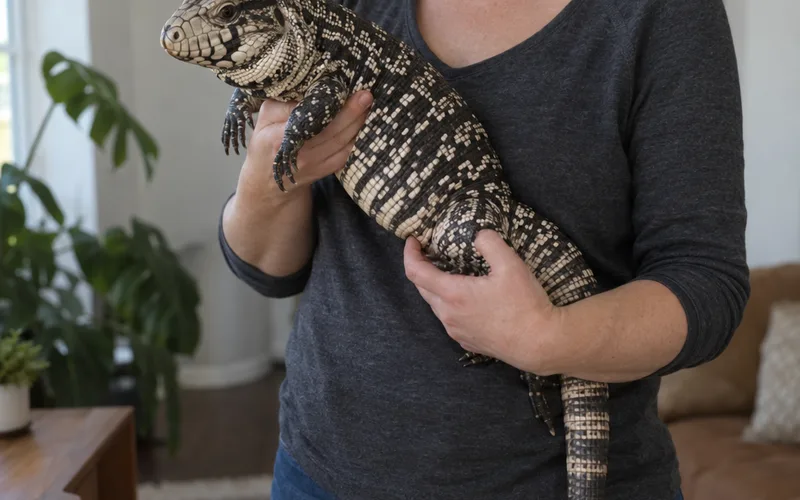
Troost-Massolin’s method is to leave a new tegu alone for its first few days while you keep tending its food and water. After that, she handles it gently but firmly and only returns it to the enclosure once it’s calm.
Size is also why releases are such a problem. Reptiles Magazine reports Argentine tegus now living in the Miami area of Florida, possibly in part from released pets, and the zoo notes that released tegus “continue to grow in number.”
Never let a tegu go because it got bigger than you expected. That’s the main reason to plan for adult size before you buy a baby.
Some keepers also let adults hibernate through winter, as wild tegus do. If you go that route, Troost-Massolin uses the adult hide box as the hibernation burrow, and the wider topic of reptile brumation is worth reading first.
Is a Tegu the Right Size Pet for You?
A tegu is a long commitment to a big animal. Reptiles Magazine says tegus live 12 to 15 years on average and as long as 20, while Pisces Pets gives up to 12 years.
That means you’ll be housing a 3- to 5-foot lizard for most of its life. Before you decide, compare these numbers with bearded dragon size and average iguana size so you know exactly what you’re signing up for.
If an 8 x 4-foot enclosure won’t fit your home, that’s useful to know now. Plenty of smaller pet lizards fit an ordinary room far more easily.
Bottom line: a tegu’s size is the first thing to plan around, not the last. Get the adult enclosure, heat and handling right, and a tegu can be a rewarding, interactive pet.
So which size question was holding you back: the enclosure, the weight or how fast your tegu will grow?
Frequently Asked Questions
What tegu gets the biggest?
The Argentine black and white tegu is the biggest, and the Australian Reptile Park calls it the largest of the tegu lizards. Its males reach about 1.2 to 1.35 meters (roughly 3.9 to 4.4 feet), and Reptiles Magazine says some top 5 feet and 20 pounds.
How long do pet tegus live?
Breeder Cindy Troost-Massolin writes in Reptiles Magazine that tegus live 12 to 15 years on average and can reach 20. Pisces Pets, a pet store, gives a shorter figure of up to 12 years, so plan for a commitment of well over a decade.
How long does it take for a tegu to reach full size?
None of the sources reviewed here gives a firm age, though the Australian Reptile Park says juveniles grow up very quickly. In one example from Reptiles Magazine, a rescued tegu went from 1 pound to just under 10 pounds in two years.
How often do tegus poop?
The sources reviewed here don’t give a set schedule. What they do say is to clean the water pan at least daily, or more often if your tegu defecates in it, since some tegus like to soak there.
Are tegu lizards dangerous?
A tegu isn’t aggressive by default, and Reptiles Magazine and Pisces Pets both describe tegus that become tame with gentle, regular handling. Still, the Australian Reptile Park notes strong jaws, sharp teeth and a tail it swings when threatened, so a scared adult deserves respect.