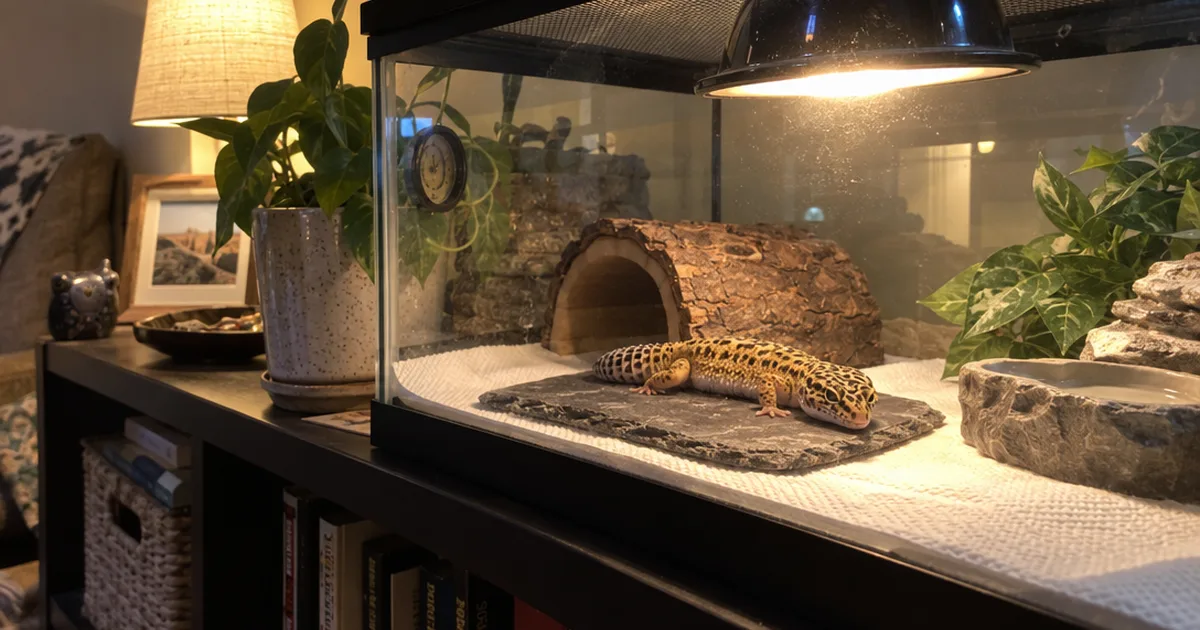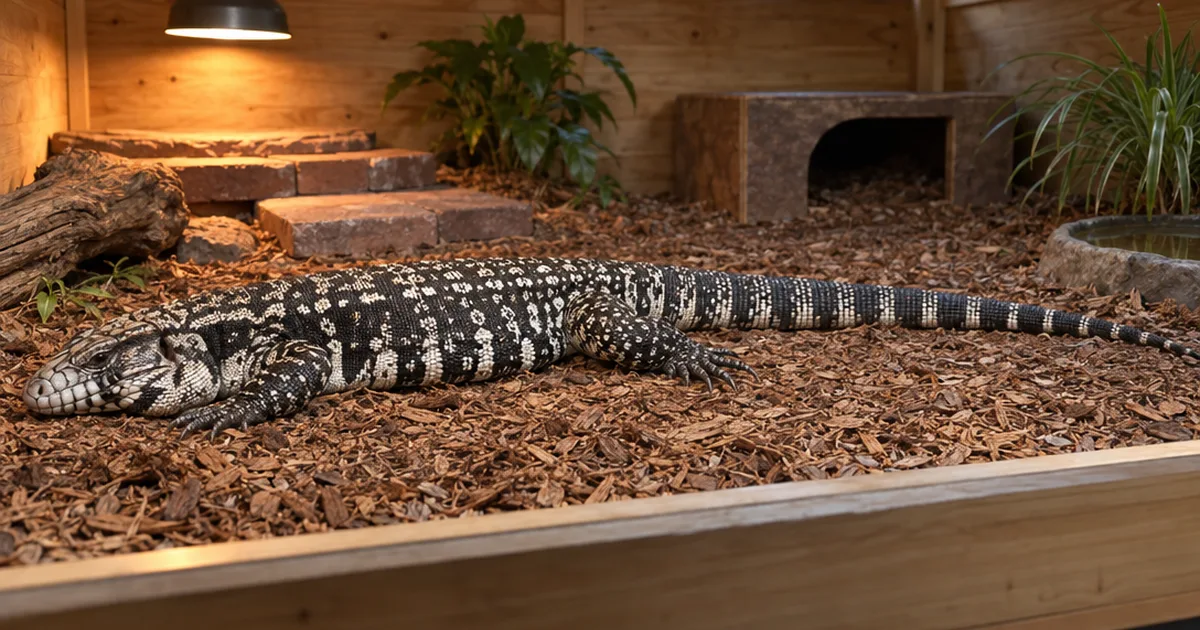
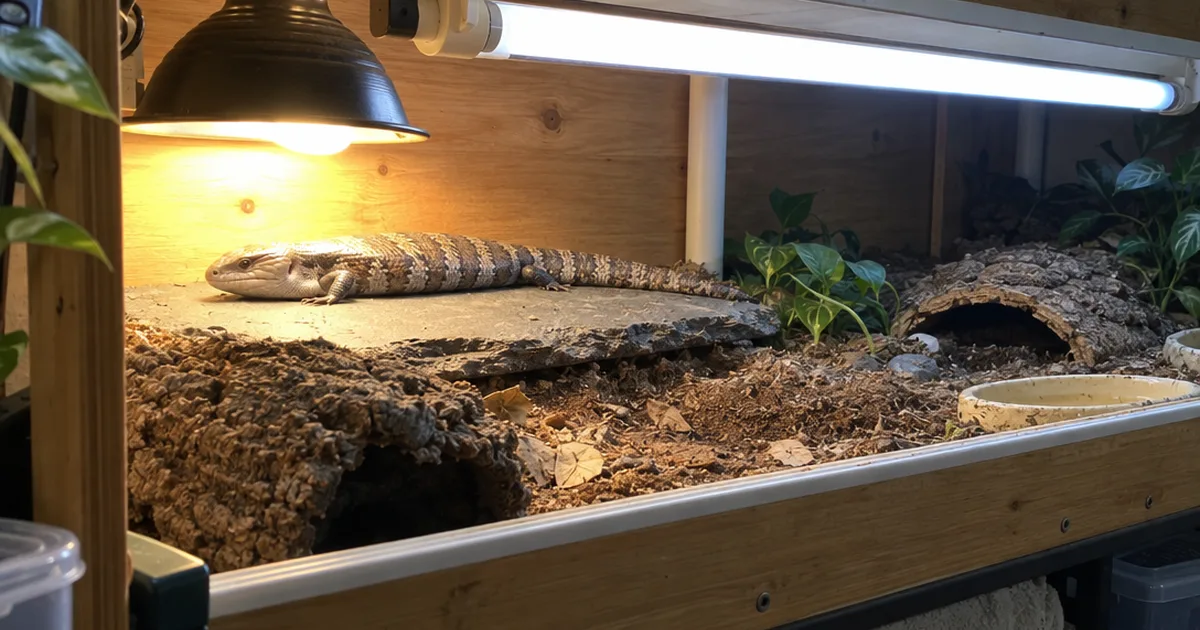
An adult blue-tongued skink should eat every 2 to 3 days, not every day.
Feed one daily and it tends to get obese, which leads to liver disease over time, say vets at South Pasadena Animal Hospital.
That’s the pattern with skink care: most problems vets treat start with the setup and routine.
Below, you’ll get skink care in 8 steps, each with the numbers to hit for the tank, heat, UVB, humidity and food, plus the signs that mean it’s time for a vet.
How to Care for a Skink Step by Step
Caring for a pet skink means building a long, warm enclosure with a basking spot, UVB and the right humidity, then feeding a varied diet on a set schedule. These steps use the blue-tongued skink, the most common pet skink in the US, as the model.
Work through them in order, since each step builds on the one before.
Step 1: Confirm Which Skink Species You Have
Start by finding out exactly which skink species you have, because humidity and heat targets change by species.
Most blue tongue skinks sold in the US are wild-caught Indonesian skinks or captive-bred Northern Australian skinks. The ReptiFiles care guide, updated in September 2025, says that’s because Australia bans exporting its native wildlife.
Those two groups need different humidity, so ask the seller for the species and whether it was captive-bred. The Northern blue-tongued skink is the usual starter, while the Merauke blue tongue skink is a bigger Indonesian type.
Step 2: Set Up a Long, Low Enclosure
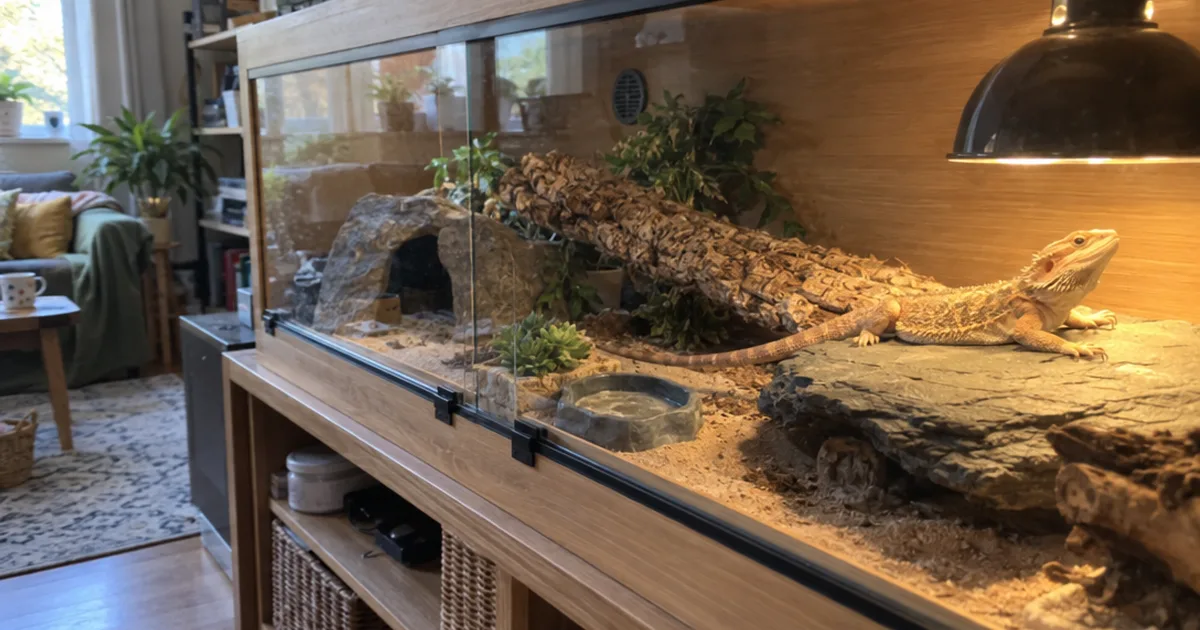
An adult blue-tongued skink needs an enclosure of at least 4 x 2 ft. South Pasadena Animal Hospital, a vet clinic that treats reptiles, puts the minimum at a 4’x2’ enclosure in its May 2026 guide.
That’s about 120 gallons, and the same vets say 5 x 2 ft or 6 x 2 ft is better.
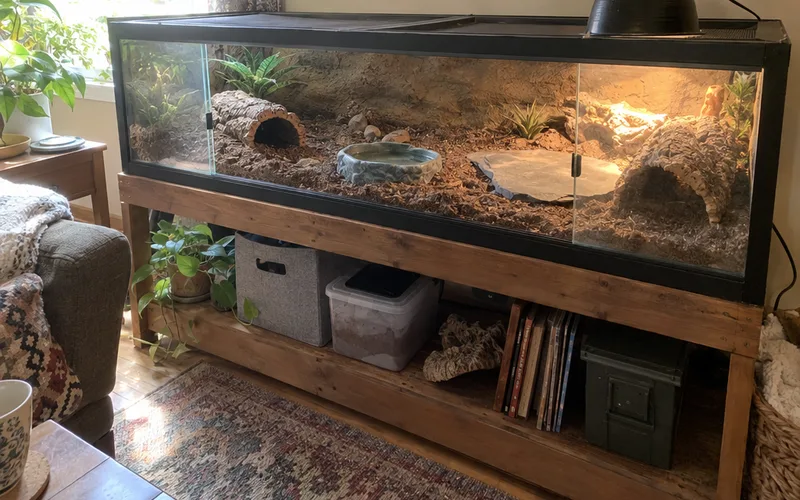
Floor space beats height, because a skink’s natural habitat is the ground and its short legs make climbing hard. A front-opening tank also makes daily access and taming easier.
For sizes by age, see the blue tongue skink enclosure size breakdown.
Step 3: Add Deep Substrate and Hides
Skinks burrow, so give them 4 to 6 inches of loose substrate that holds a tunnel. South Pasadena Animal Hospital suggests topsoil mixed with play sand at about 60/40, or topsoil with coconut fiber, which holds humidity.
Then add at least 2 hides: one on the warm end and one on the cool end.
A humid hide packed with damp sphagnum moss helps during sheds. And if your pet spends hours half-buried in the bedding, relax: that’s normal skink behavior.
The full build is in the blue tongue skink enclosure setup guide.
Step 4: Build a Heat Gradient With a Hot Basking Surface
A skink needs a temperature gradient: a hot basking spot, a warm side and a cooler end. South Pasadena Animal Hospital recommends a basking surface of 100-105°F, a warm side of 85-90°F and a cool side of 75-80°F.
Notice the word “surface.”
Skinks warm up through belly contact, so put flat slate or tile under the basking lamp. A hot lamp with no hot stone to lie on works less well, the clinic notes.
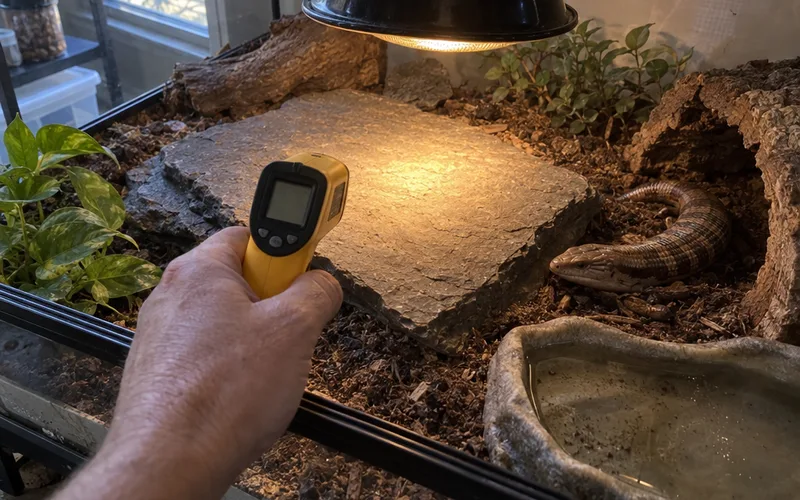
At night, the same vets say a drop to 70-75°F is fine, so the basking lamp can go off with the lights.
Measure the basking stone with an infrared temperature gun, because warm air can hide a stone that’s too cool. For how to read and adjust any gradient, see these terrarium temperature basics.
Step 5: Add UVB Lighting on a Daily Cycle
Skinks are diurnal, meaning active by day, and they need UVB light to use calcium and keep bones strong. South Pasadena Animal Hospital recommends a T5 HO 10.0 or 12% UVB tube for 12 to 13 hours a day in summer and 10 to 11 in winter.
Here’s the catch most keepers miss:
The clinic says to replace UVB bulbs every 6-12 months, because output drops before the bulb looks dead. A glowing lamp can still be failing your skink.
Mount the tube beside the heat lamp and put both on a timer. Window sunlight doesn’t count, because ordinary glass blocks UVB.
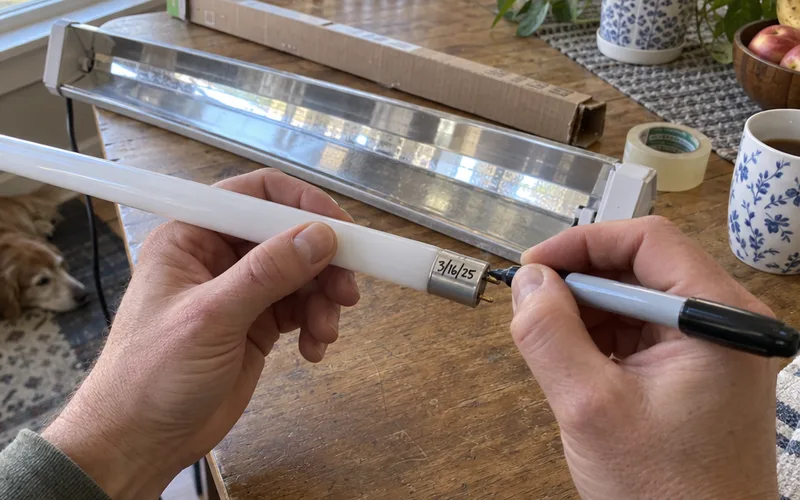
Pro Tip: Write the install date on the bulb’s base.
Step 6: Match Humidity to the Species
Humidity is where skink species split. South Pasadena Animal Hospital says Northern blue-tongued skinks do well at 40-60% relative humidity, while Indonesian subspecies need 60-80%.
Too much damp air is risky for a Northern. The clinic links respiratory infections to humidity that’s too high for Northern skinks.
To raise it, mist one end of the terrarium lightly and keep the humid hide damp. Track it with a digital hygrometer, and add ventilation if a Northern’s tank stays above 60%.
Step 7: Feed a Balanced Omnivore Diet
Blue-tongued skinks are omnivores, so they eat both animal and plant food. South Pasadena Animal Hospital describes a good adult diet as roughly 40-50% protein and 50-60% vegetables and fruits.
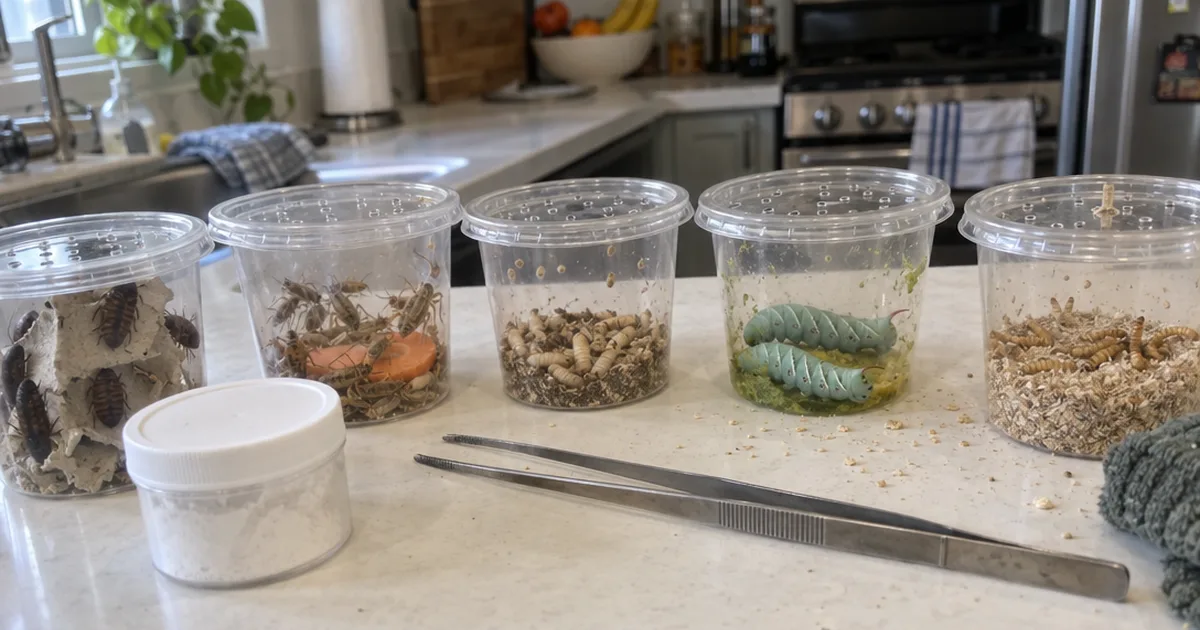
For protein, the clinic lists lean unseasoned turkey or chicken, boiled eggs, quality wet cat food, dubia roaches and snails. Crickets and mealworms work too, ideally after gut-loading the insects for extra nutrition.
Good staple plants include collard greens, mustard greens, dandelion greens, squash, bell pepper, snap peas and green beans. Fruits such as berries and mango are an occasional extra because of their sugar.
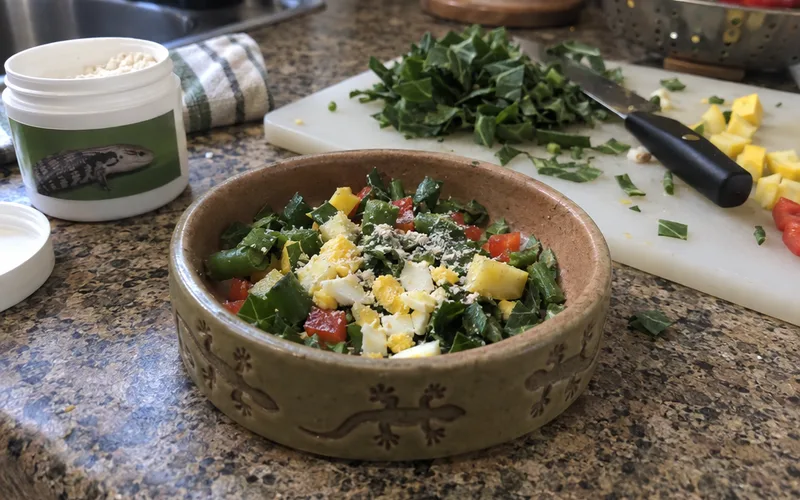
Feed juveniles under a year every 1 to 2 days and adults every 2 to 3 days. Dust food with a calcium supplement without D3 at most meals, plus a multivitamin with D3 once a week.
For portions and a weekly menu, see the full blue tongue skink diet plan.
Step 8: Keep a Daily and Weekly Routine
Each day, check temperatures and humidity, refresh the drinking water, remove waste and leftovers, and look your skink over. Weigh it regularly on the same scale and note anything unusual.
Handle your skink with its whole body supported, and never lift it by the tail.
Healthy reptiles can carry Salmonella, so wash your hands after handling. The Salmonella risk from reptiles is easy to manage once that’s a habit.
What You Need to Care for a Skink
A skink care kit has 4 parts: the enclosure and substrate, heat and UVB lights, measuring tools, and calcium and vitamins. Buy everything before the skink comes home, so you can run the setup for a few days and check the numbers.
The two tools people skip are the ones that matter most: an infrared temperature gun for the basking stone and a digital hygrometer for humidity.
Skink Care Sheet at a Glance
South Pasadena Animal Hospital’s May 2026 blue-tongued skink care guide gives these starting targets for an adult:
| Setting | Target for an adult blue-tongued skink |
|---|---|
| Enclosure | 4 x 2 ft minimum (about 120 gallons) |
| Substrate depth | 4 to 6 inches |
| Basking surface | 100-105°F |
| Warm side | 85-90°F |
| Cool side | 75-80°F |
| Night | 70-75°F |
| Humidity | 40-60% Northern, 60-80% Indonesian |
| UVB bulb | Replace every 6 to 12 months |
| Adult feeding | Every 2 to 3 days |
ReptiFiles lists a hotter basking range of 105-115°F, so check your species’ guide before you settle on one number.
Which Skinks Make Good Pets?
The Northern blue-tongued skink (Tiliqua scincoides intermedia) is the best first skink for most people. South Pasadena Animal Hospital calls it the most common skink in the pet trade: large, robust, calm and easy to tame.
Other species each change one part of the setup:
- Indonesian blue-tongues (T. gigas complex): more humidity, around 60-80%.
- Merauke blue-tongues: large and active, so they need more space.
- Blotched blue-tongues: from cooler parts of Australia, with different heat needs.
- Schneider’s skinks: burrowers with their own Schneider skink enclosure size targets.
- Red-eyed crocodile skinks: their own housing needs, covered in red-eyed crocodile skink enclosure size.
Still deciding on a lizard? Compare skinks with the best pet lizards for your space first.
Can You Keep Skinks as Pets?
Yes, you can keep skinks as pets, and blue-tongued skinks are widely sold in the US. Plan for a long commitment: the ReptiFiles care guide puts their average lifespan at 15 to 20 years and notes they can live past 35.
They’re also big lizards, reaching 18 to 24 inches, so that 4 x 2 ft tank is a lifelong space cost.
Skinks are also solitary.
Keep one skink per enclosure, because they’re territorial and cage mates can badly injure each other. Skinks suit people who want a calm ground-dwelling pet, and many skills carry over from general lizard care.
What Not to Feed a Blue Tongue Skink
Don’t feed a blue tongue skink spinach, beet greens or chard as staples, seasoned meat, or cat food with onion or garlic. South Pasadena Animal Hospital explains that spinach, beet greens and chard are high in oxalates, which bind calcium.
Fruit is the other common mistake.
The clinic calls fruit fine now and then but high in sugar. And don’t overfeed even good food: skinks don’t stop on their own, and obesity shows as fat deposits behind the front legs.
Key Takeaway: Build meals on lean protein and leafy greens, and treat fruit as a garnish.
Common Skink Health Problems and When to See a Vet
The most common skink health problems are metabolic bone disease, retained shed, respiratory infections, mouth rot and obesity. South Pasadena Animal Hospital says all of them trace back to husbandry gaps, and it sees metabolic bone disease most often.
Watch for these signs:
- Metabolic bone disease: trembling, a soft jaw, sluggish movement or bones that break easily.
- Retained shed: dry skin stuck on toes or around the eyes.
- Respiratory infection: wheezing, mucus at the nose or mouth, or open-mouth breathing.
- Mouth rot: redness, swelling or discharge along the gums.
Stuck shed on toes can cut off blood flow. Soak your skink in shallow warm water for 15 to 20 minutes, then roll the shed loose with a damp swab, and read up on stuck shed in reptiles if it keeps happening.
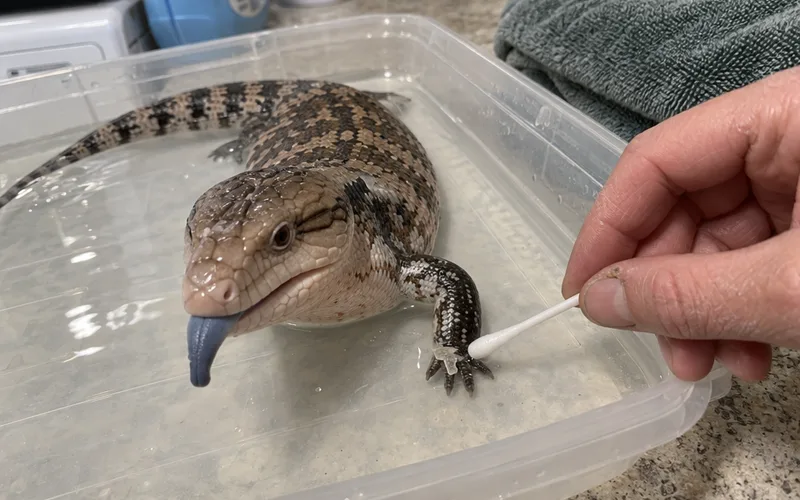
The clinic recommends a yearly checkup with a reptile veterinarian. Go sooner for breathing signs, mouth swelling, weight loss, odd behavior or no eating for over 4 to 6 weeks outside reptile brumation, a slow winter rest.
Interesting Facts About Skinks
Blue-tongued skinks can see UVA light, and their blue tongue reflects it, according to the ReptiFiles care guide. Recent research suggests the tongue may mostly be a signal to other skinks.
A few more facts worth knowing:
- They give birth to live young: blue-tongued skinks don’t lay eggs.
- They can drop their tail: it distracts a predator, and it grows back as a stump.
- They’re omnivores: wild skinks eat plants, fruits, insects and snails.
That tail trick is one more reason to never grab a skink by the tail.
Frequently Asked Questions
How do you look after a blue tongue lizard?
A blue tongue lizard needs a 4 x 2 ft or larger enclosure, a hot basking surface with a cooler end, UVB lighting, deep loose substrate and humidity matched to its subspecies. Feed adults a mix of protein and vegetables every 2 to 3 days, dust food with calcium and book a yearly vet check.
How often should you feed a skink?
An adult blue-tongued skink should eat every 2 to 3 days, and a juvenile under a year every 1 to 2 days, according to South Pasadena Animal Hospital. Adults fed daily tend to become obese.
Can two skinks live together?
No, skinks should not share an enclosure, because they’re territorial and cage mates can fight and badly injure each other. Give each skink its own setup.
How long do pet skinks live?
Pet blue-tongued skinks usually live 15 to 20 years, and the ReptiFiles care guide notes they can live past 35. Plan for that before you buy one.
Do skinks need a heat lamp at night?
Skinks usually don’t need a heat lamp at night, because South Pasadena Animal Hospital says a nighttime drop to 70-75°F is fine for blue-tongued skinks. Turn the basking lamp off with the day lights, and add gentle heat only if your room drops below that range.
What is the best skink for beginners?
The Northern blue-tongued skink is the most common pick for beginners, because vets describe it as large, robust, calm and easy to tame. Its 40-60% humidity is also easier to hold in a normal home than an Indonesian skink’s.
Final Thoughts
Good skink care comes down to a few measured numbers: a long enclosure, a hot basking surface, working UVB, the right humidity and meals every 2 to 3 days for adults.
This week, buy a temperature gun and hygrometer, and check your basking surface and humidity against the care sheet above.