Getting the Schneider skink enclosure size right is the first big setup decision you’ll make. In this guide, you’ll get exact sizes in inches, centimeters and gallons for young skinks, adults and small groups.
Why spell it all out? Because the popular care sheets disagree, and their minimums run from about 19 gallons all the way up to 120.
I’ll show you where each number comes from, which one I’d pick, and how the size you choose shapes heat, UVB lighting, substrate depth and decor. Let’s dive right in.
Schneider Skink Enclosure Size: The Short Answer
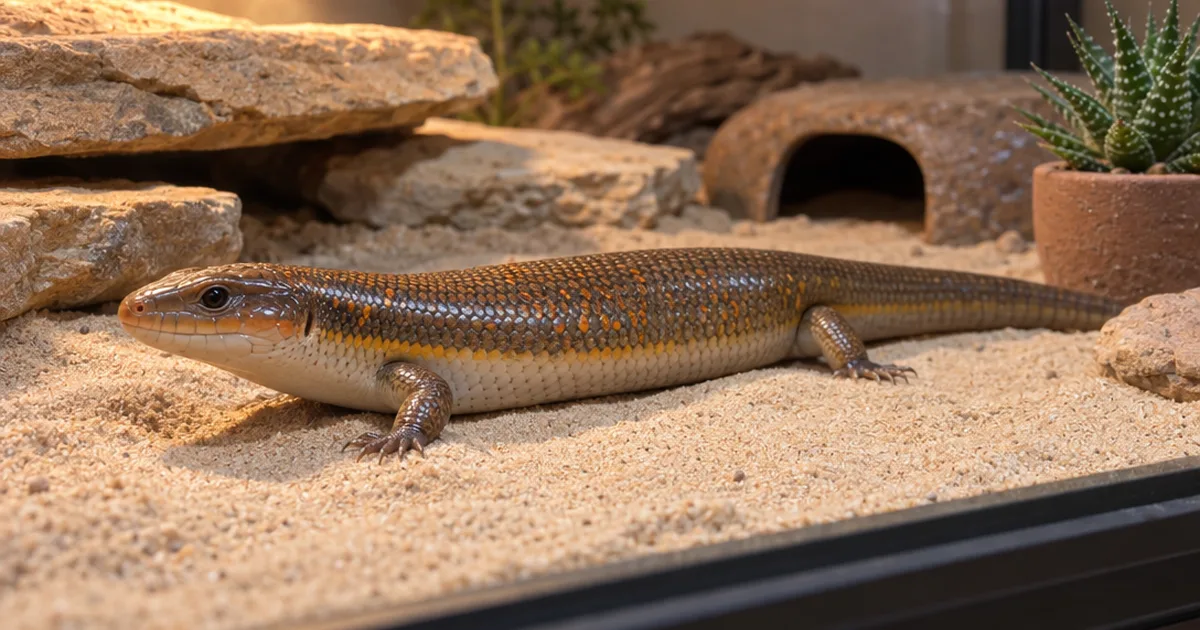
Here’s the deal: an adult Schneider’s skink does best in an enclosure about 4 feet long, 2 feet deep and 2 feet tall. That’s 48 x 24 x 24 inches, or roughly 122 x 61 x 61 cm.
Dubia.com’s care sheet sets its minimum at 36 x 18 x 18 inches for a skink under 14 inches long, and it recommends a 4x2x2 for larger skinks. Its writers add that larger is always better, because a skink will use whatever room you give it.
So which one should you buy? If your skink is already close to adult size, skip the middle step and go straight to a 4x2x2.
That one purchase covers the deep substrate, the wide heat gradient and the floor space your skink needs for the rest of its life. If you’re starting with a small juvenile, the 36 x 18 x 18 works as a starter, as long as you plan the upgrade before it passes about 14 inches.
How Big Do Schneider’s Skinks Get?
Enclosure size starts with the animal, so let’s look at adult length first. Dubia.com describes Schneider’s skinks as 12 to 18 inch, diurnal, terrestrial lizards found from North Africa to central Asia.
Melissa Kaplan’s Herp Care Collection, which places this skink from northwestern Africa east to Western Asia, gives a similar 32 to 45 cm, or 13 to 18 inches. The Critter Depot’s care guide puts adults at about 16 to 18 inches.
That’s a big animal. Dubia.com notes a robust, cylindrical body, short limbs and a long tail, and this skink spends its day walking, digging and turning around on the floor.
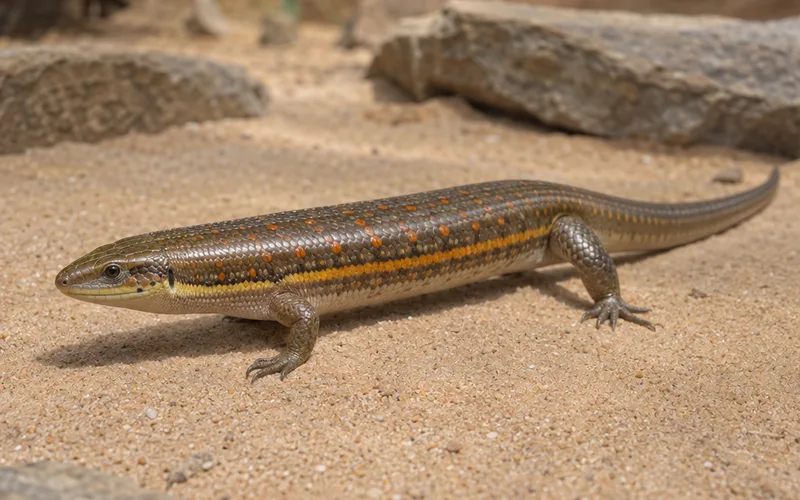
Picture it this way. An 18-inch skink in a 30-inch enclosure has less than two body lengths to work with, while a 48-inch enclosure gives it more than two and a half.
These lizards also stick around for a long time. Dubia.com says they may live 15 years or more with good care, so the enclosure you buy now is a long-term home.
Check Which “Berber Skink” You Have
Pet stores often sell this lizard as a Berber skink, and that name causes real confusion. The Critter Depot’s guide explains that two different animals share that name: Schneider’s skink and the Algerian orange-tailed skink, Novoeumeces schneideri algeriensis.
Both have been filed under the genus Eumeces at different times, so older care sheets switch between names. The Critter Depot notes that the Algerian form is a bit larger and stockier, which is one more reason to size up rather than down.
Not sure which name is current?
The Reptile Database, a reference catalog of reptile species, has been online since November 1995. It’s a sensible place to check a scientific name before you compare care sheets.
What the Care Sheets Recommend (and Why They Disagree)
Search for this topic and you’ll find very different answers. Here’s how the top care sheets compare once you convert everything into the same units:
| Care sheet | Size (inches) | Size (cm) | Volume (gallons) |
|---|---|---|---|
| The Critter Depot minimum | 30 x 12 x 12 | 76 x 30 x 30 | About 19 |
| Herp Care Collection | Not given | Not given | 30 to 50, ideally 50 |
| Dubia.com, skink under 14 in | 36 x 18 x 18 | 91 x 46 x 46 | About 50 |
| Dubia.com, larger skinks | 48 x 24 x 24 | 122 x 61 x 61 | About 120 |
The gap is huge. The Critter Depot’s minimum holds about 4,300 cubic inches of space, while a 4x2x2 holds more than 27,000.
Why such a spread? It comes down to what each source is aiming for, since a bare minimum keeps a skink alive while a larger space lets it behave like a skink.
The Herp Care Collection puts it plainly. Larger enclosures allow more room and more natural behaviors, while smaller or overcrowded ones lead to stress and reduced activity.
It also advises starting your skink out in an adult-sized tank, at least 30 to 50 gallons and ideally 50. Treat the smallest number in that table as a floor you never go below, not a target to aim for.
Is a 20-Gallon Tank Big Enough?
Only by the lowest standard out there. A 20-gallon tank roughly meets The Critter Depot’s bare minimum and none of the others.
Gallons can fool you. Amazon’s listings show a 20-gallon reptile terrarium that measures 28 x 12 x 12 inches.
That’s shorter than The Critter Depot’s 30-inch minimum, and it’s only 12 inches from front to back.
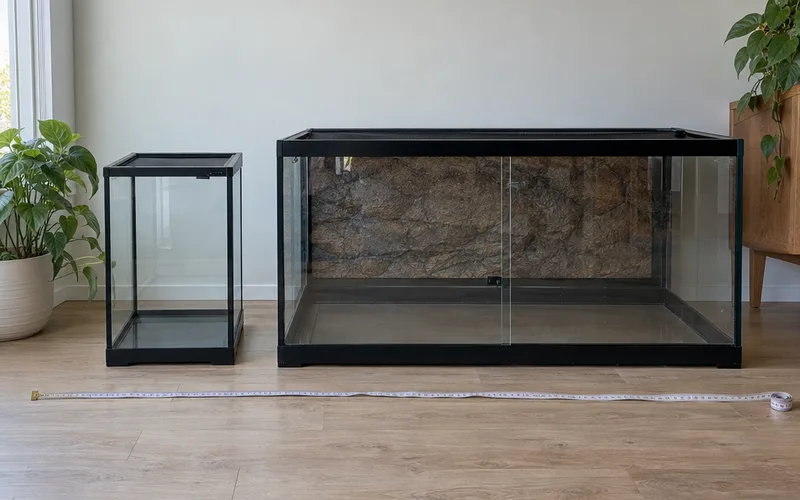
Now put an 18-inch skink in that box. It can barely turn around, and there’s no room to build a hot end and a cool end far enough apart to make a difference.
Gallons also hide shape. Two tanks with the same volume can have very different floor areas, and floor area is what a ground-dwelling skink actually uses.
So when you shop, ignore the gallon label at first and read the length and depth. For a Schneider’s skink, the footprint tells you far more than the volume does.
Pro Tip: You can check any listing yourself. Multiply length x depth x height in inches, then divide by 231, the number of cubic inches in a US gallon.
Why I Recommend a 4x2x2 for Adults
A 4x2x2 enclosure is 4 feet long, 2 feet deep and 2 feet tall. Amazon’s reptile-cage listings sell this size as a 120-gallon tank, which matches the volume math.
Dubia.com recommends this size for skinks over 14 inches, and the reasons stack up fast:
- Length for a real gradient. Four feet lets you put the heat lamp at one end and keep the other end much cooler.
- Depth for digging. Two feet front to back gives your skink room to tunnel, turn and explore.
- Height for deep substrate. Two feet tall leaves space for several inches of substrate plus a safe gap below the lights.
- Room for a small group. Dubia.com says a 4x2x2 can comfortably hold up to three skinks.
The result? One enclosure that works from a growing juvenile to a full adult, with no second upgrade later.
If your room allows something bigger, go for it. Dubia.com’s care sheet sums it up: larger is always better, and your skink will use the space.
Floor Space Beats Height for This Skink
Schneider’s skinks are ground dwellers. The Critter Depot’s guide describes them as terrestrial lizards that prefer floor space over climbing area.
That changes how you read enclosure listings. For example, Amazon lists a 12x12x18 front-opening PVC enclosure described as a climbing habitat for geckos and tropical reptiles.
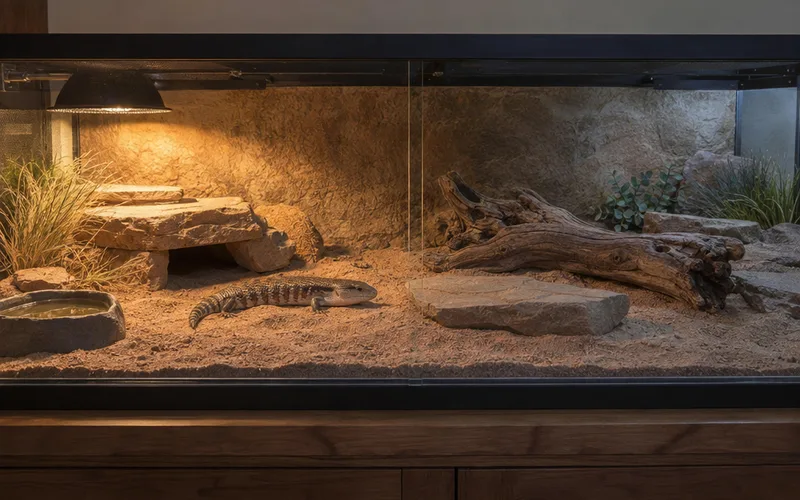
That shape suits a climber. For a skink that digs and patrols the ground, a tall, narrow box wastes most of its volume.
Extra height can even cause harm. The Critter Depot reports that some keepers gave their skink a very high perch, only to have it fall and injure a leg.
Its fix is simple: use flat rocks and large driftwood set right on the enclosure floor.
How Deep Substrate Changes the Height You Need
So why bother with 18 to 24 inches of height at all? Because a good chunk of it ends up filled with substrate.
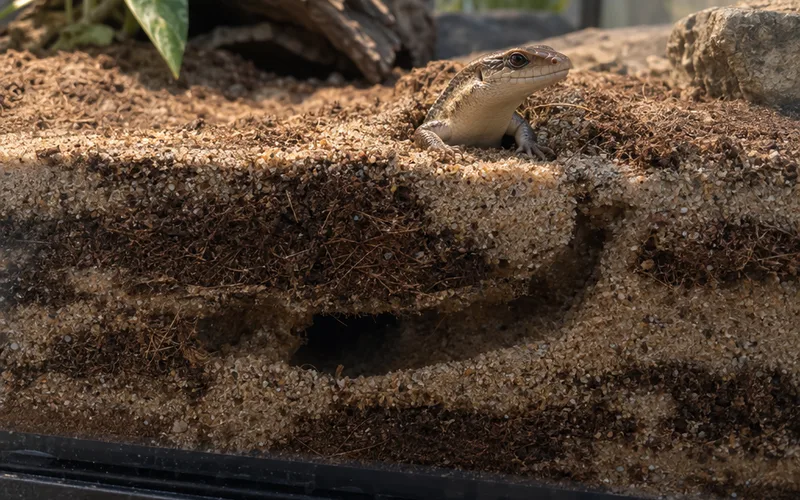
These skinks love to burrow. Dubia.com calls for at least 4 inches of substrate, the Herp Care Collection suggests 3 to 4 inches of clean playground sand, and The Critter Depot goes up to 6 inches.
Run the numbers on an 18-inch-tall enclosure with 6 inches of substrate. You’re left with 12 inches of open air, and some of that goes to rocks, hides and a raised platform.
That’s why I treat 18 inches as the minimum height and 24 inches as the comfortable choice for an adult. The extra height gives you room to build up a warm perch without crowding the lights.
Plan for the Substrate You’ll Need
Bigger floors also mean more substrate to buy. A 4x2x2 filled 4 inches deep takes about 4,600 cubic inches, or roughly 2.7 cubic feet, while a 36 x 18 footprint takes about 1.5 cubic feet.
Budget for refills, too. Dubia.com recommends removing waste and soiled substrate every day and replacing all of it every 3 to 4 months.
The same care sheet suggests changing the water daily and scrubbing the bowl with a reptile-safe disinfectant every week.
Note: The sources don’t agree on what to dig in. Dubia.com recommends sand such as Exo Terra Desert Sand, while The Critter Depot prefers coconut fiber or a similar organic mix with no more than 30 percent sand.
Why the limit? The Critter Depot warns these skinks are susceptible to sand compaction.
How Enclosure Size Shapes Heat and UVB
Size isn’t only about room to roam. It also decides whether you can build the temperature range your skink needs.
According to Dubia.com, Schneider’s skinks come from arid to semiarid habitat with sandy, stony soil and scrubby vegetation. In an enclosure, they need a hot basking spot at one end and a cooler zone at the other, so they can move between them to control their body temperature.
The care sheets give these ranges:
- Dubia.com: a basking surface of 105 to 115°F, a cool side of 75 to 85°F and nights as low as 65°F.
- The Critter Depot: a cool end of 75 to 82°F and a warm end of 90 to 105°F.
- Herp Care Collection: daytime temperatures of 73 to 88°F with a basking area of 95°F.
These ranges don’t fully match, but they share one thing: a wide spread between hot and cool. That spread needs distance, because in a short enclosure the heat from one lamp washes over the whole floor and the cool side never really cools off.
Dubia.com suggests one or two low-wattage halogen flood bulbs on one side of the enclosure. A digital probe thermometer on the cool side then tells you whether your terrarium temperature gradient is actually working.
Fitting the UVB to the Enclosure
Enclosure size also sets your lighting plan. Dubia.com recommends a UVB bulb roughly half the length of the enclosure, which works out to about 24 inches in a 4x2x2.
It also gives basking distances. The basking surface should sit 13 to 15 inches below the bulb when the light shines through mesh, and 17 to 18 inches below it without mesh.
In practice, the math is simple. Add 4 inches of substrate to an 18-inch-tall enclosure, and the floor sits about 14 inches below a mesh-top bulb.
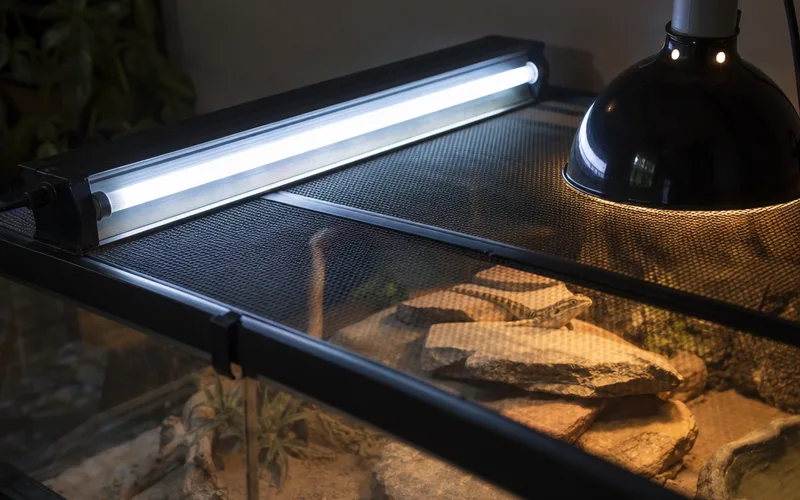
In a 24-inch enclosure, you’d raise the basking spot on secured flat rocks to land in the same range.
Bulb strength depends on height, too. Dubia.com suggests an Arcadia T5 HO 12% bulb for enclosures 16 to 18 inches tall.
It also recommends a full-length grow lamp, such as a T5 HO fluorescent, for extra brightness, so measure your fixture space along with the floor.
Keep Humidity Low
A bigger enclosure doesn’t change one rule: keep the air dry. The Critter Depot says to keep it below 40 percent, and Dubia.com says under 50 percent on average.
Your skink can still have one damp spot. The Herp Care Collection suggests mixing sand with orchid bark or cypress mulch in one area, then wetting it to make a small humid microhabitat.
Housing Juveniles: Start Big or Size Up?
You’ve got two options with a young skink. You can start it in a smaller enclosure, such as Dubia.com’s 36 x 18 x 18, or follow the Herp Care Collection’s advice to start it out in an adult-sized tank.
I lean toward the adult-sized enclosure, as long as you furnish it well. Dubia.com recommends covering three sides of the enclosure to help a skink feel more secure, and that matters even more when a small skink is in a big space.
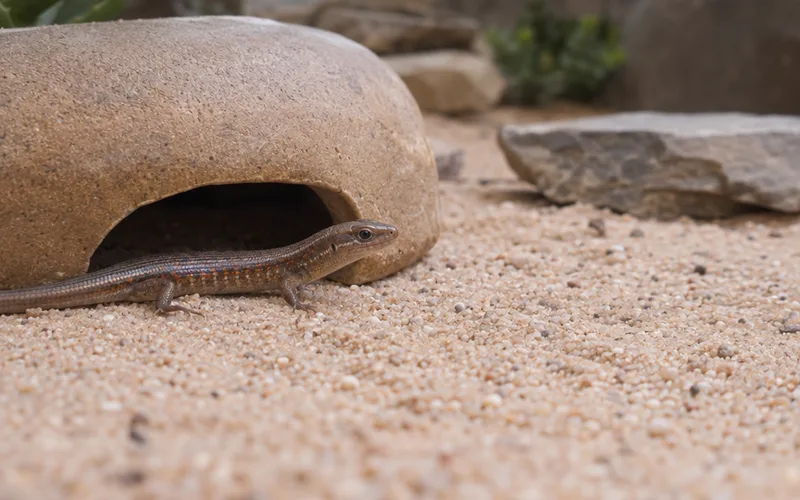
The catch is feeding. The Critter Depot notes these skinks can be slow and sometimes can’t catch fast-hopping crickets, and that stray crickets can end up chewing on your pet.
In a large enclosure, loose insects have more places to hide. Offering mealworms or other feeders with feeding tweezers, which Dubia.com also suggests for taming, helps you see what your skink actually eats.
That matters most for young skinks, since Dubia.com suggests feeding juveniles daily and adults two to three times a week.
How Much Space Do Two or Three Skinks Need?
A Schneider’s skink is perfectly happy living alone. Dubia.com says they do fine when housed singly, and it suggests avoiding cohabiting unless you intend to breed.
If you do keep a group, size the enclosure for the group rather than for one animal. The care sheets break it down like this:
| Group | Care sheet guidance | Space to plan for |
|---|---|---|
| One skink under 14 in | Dubia.com minimum | 36 x 18 x 18 in |
| One adult | Dubia.com recommendation | 48 x 24 x 24 in |
| Two skinks | Herp Care Collection: a couple fit in 50 gallons | 50 gallons or more |
| Up to three skinks | Dubia.com: no more than one male | 48 x 24 x 24 in |
The male rule is the one to take seriously. The Critter Depot says two females or a mated pair can share an enclosure, but never two adult males.
It also says enclosure size should go up with every extra skink. Adding another kind of reptile is a separate question, and the risks of housing different reptiles together go well beyond space.
The Critter Depot warns that this skink’s high temperatures may not suit many popular reptile species. If you’re tempted to add a tank mate of another kind, do your research first.
Furnishing the Space So Your Skink Uses It
A big enclosure only helps if your skink has reasons to use all of it. Dubia.com puts it bluntly: it doesn’t matter how big the enclosure is if you don’t put things in it for your pet to use.
Good additions from the care sheets include:
- Sturdy logs, low ledges and large driftwood set on the floor
- Stacks of flat rocks, secured so they can’t shift
- Extra hides, such as a heavy ceramic hide that’s low and wide with a small entrance
- Live or artificial plants, with potted succulents if you go live
- A water bowl big enough to climb into but shallow enough to climb out of
That rock rule is a safety issue, not a style choice. The Herp Care Collection warns that unsupported rocks may sink and crush a lizard that has burrowed beneath them, so set rocks on the enclosure floor before you add substrate.
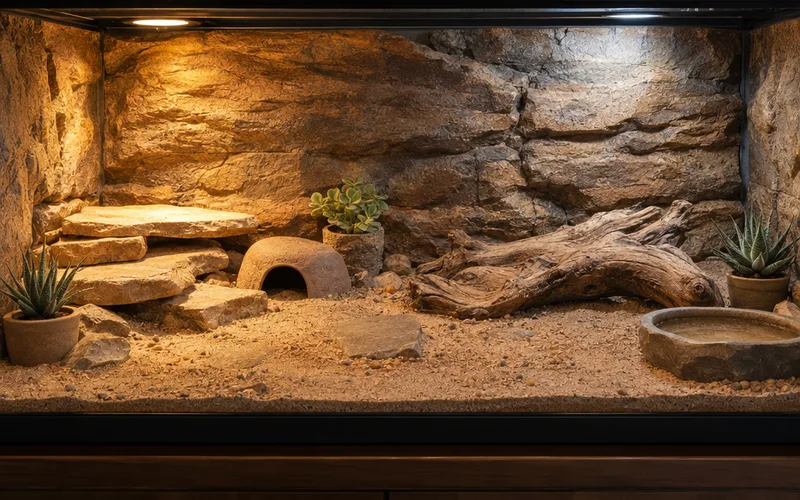
Spread these pieces across the whole floor instead of piling them at the warm end. That turns your extra square footage into everyday enrichment your skink can explore, from the hot end to the cool hide.
Choosing the Enclosure Itself
Once you know the footprint, choosing the actual enclosure gets much easier. The Critter Depot says many keepers use Exo Terra Large-Low terrariums or T3 and T8 terrestrial enclosures for adults.
Their low, long shape is exactly what a ground-dwelling burrower needs.
Front-opening doors are worth looking for. Dubia.com advises never grabbing a skink from above and always scooping from below, and a front door lets you reach in from the side.
Where to Put the Enclosure
Where you put the enclosure matters, too. The Critter Depot warns that direct sunlight on a tank can push temperatures to 110°F or higher.
A sunny window doesn’t help with lighting either. Dubia.com points out that glass and plastic block UVB, so the window adds heat without the benefit.
Can’t find a 4x2x2 that fits your room? Building your own enclosure lets you match the length and depth exactly, then fit the lights to the size you built.
How Schneider’s Skinks Compare With Other Skinks
“How big should a skink enclosure be?” has a different answer for every species.
The method stays the same, though. Start from the adult length, then ask whether the animal digs on the ground or climbs.
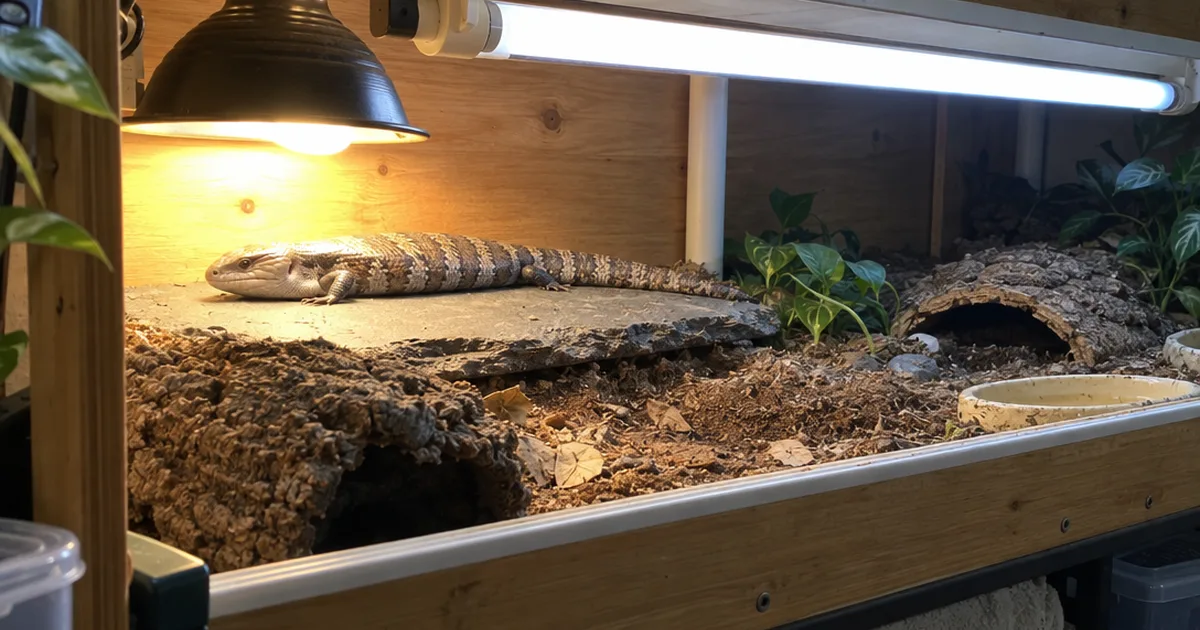
Blue tongue skinks follow their own sizing numbers, so check those before you reuse a Schneider’s plan. Their enclosure setup also differs in the details, from substrate to decor.
Red-eyed crocodile skinks are a different species with their own space needs. Check them before you assume one skink setup fits all.
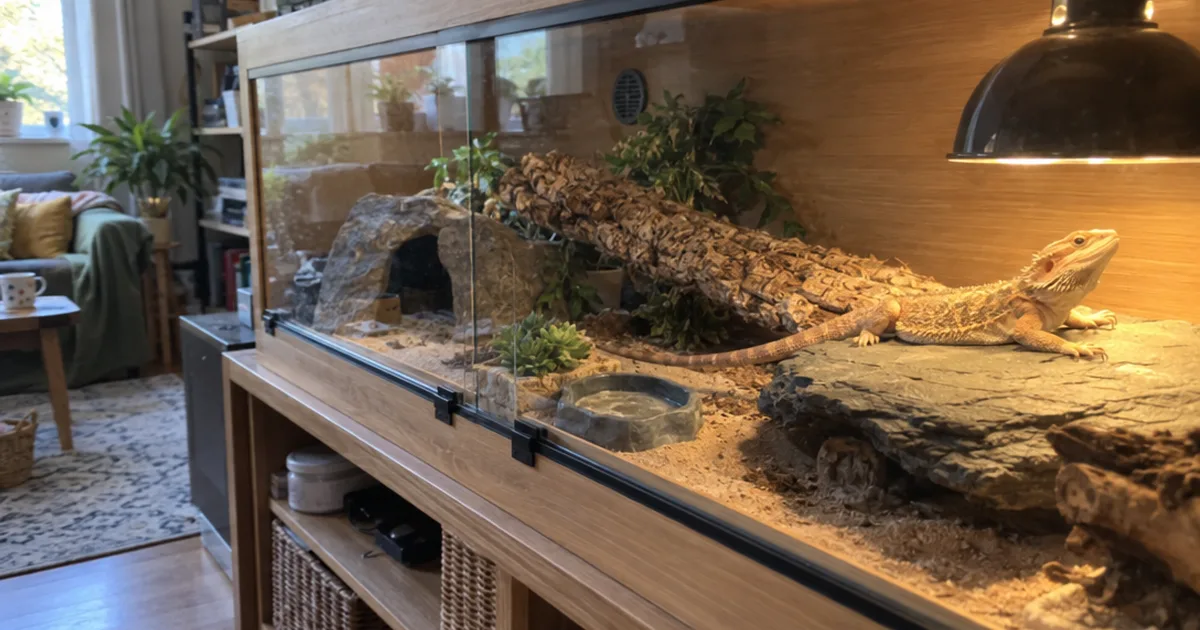
If you’re comparing skinks with other popular lizards, a bearded dragon’s tank size is another useful reference point. Space is also only one part of skink care, since diet, handling and lighting all work together once your skink moves in.
Still choosing your first lizard? The basics of lizard care show how heat, UVB and diet needs differ between common pet lizards.
A list of beginner-friendly pet lizards can also help you compare space needs before you buy.
Common Schneider’s Skink Enclosure Mistakes
Most enclosure problems come from a handful of repeat mistakes. Watch for these:
- Buying by gallons. A tank’s gallon label says nothing about its footprint.
- Going tall and narrow. Height suits climbers, not a ground-dwelling burrower.
- Skimping on substrate. Less than about 4 inches leaves your skink nowhere to dig.
- Housing two adult males together. Both The Critter Depot and Dubia.com advise against it.
- Stacking rocks on loose sand. Rocks that sink can crush a skink tunneling underneath.
- Parking the tank in a sunny window. Trapped sunlight can overheat the whole enclosure.
Each of these is easy to fix before your skink moves in, and much harder to fix after.
The Bottom Line
For an adult Schneider’s skink, a 4x2x2 enclosure is the size I’d plan around. A 36 x 18 x 18 works for a skink under 14 inches, and anything smaller only meets the barest minimum.
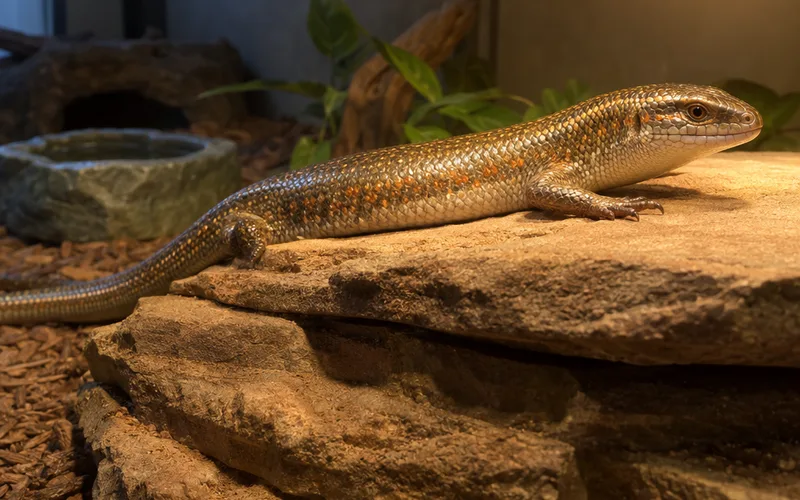
Pick floor space over height, give your skink deep substrate and build a real hot-to-cool gradient. So, which setup are you going with: a starter enclosure now, or the full 4x2x2 from day one?
Frequently Asked Questions
Are Schneider skinks good pets for beginners?
They can be, as long as you’re ready for the setup. Dubia.com says they can become handleable pets with effort, and The Critter Depot calls them excellent pets when they’re gently handled and properly cared for.
Are Schneider skinks rare?
No, pet stores sell them fairly often, usually under the name Berber skink. The Critter Depot notes that a store skink priced around $30 is almost certainly a Schneider’s, while one closer to $300 is probably an Algerian orange-tailed skink.
What is the average lifespan of a Schneider's skink?
Dubia.com says they may live 15 years or more with good care, and The Critter Depot puts the figure at about 17 years. That’s why it pays to buy an enclosure your skink can grow into and keep for life.
Can Schneider skinks be housed together?
They can, but Dubia.com suggests avoiding it unless you plan to breed, and it recommends no more than one male per enclosure. The Critter Depot agrees that two females or a mated pair can share a home, but never two adult males.
What is the ideal setup for a Schneider's skink?
The care sheets describe a long, low enclosure such as a 4x2x2 with at least 4 inches of diggable substrate, a heat lamp at one end and a UVB bulb about half the enclosure’s length. Add low humidity, several hides and secured flat rocks to warm up on.
How big of a cage do lizards need?
It depends on the species’ adult length and whether it climbs or lives on the ground. Ground dwellers like Schneider’s skinks need a long, wide footprint, while climbers such as many geckos need a taller enclosure.