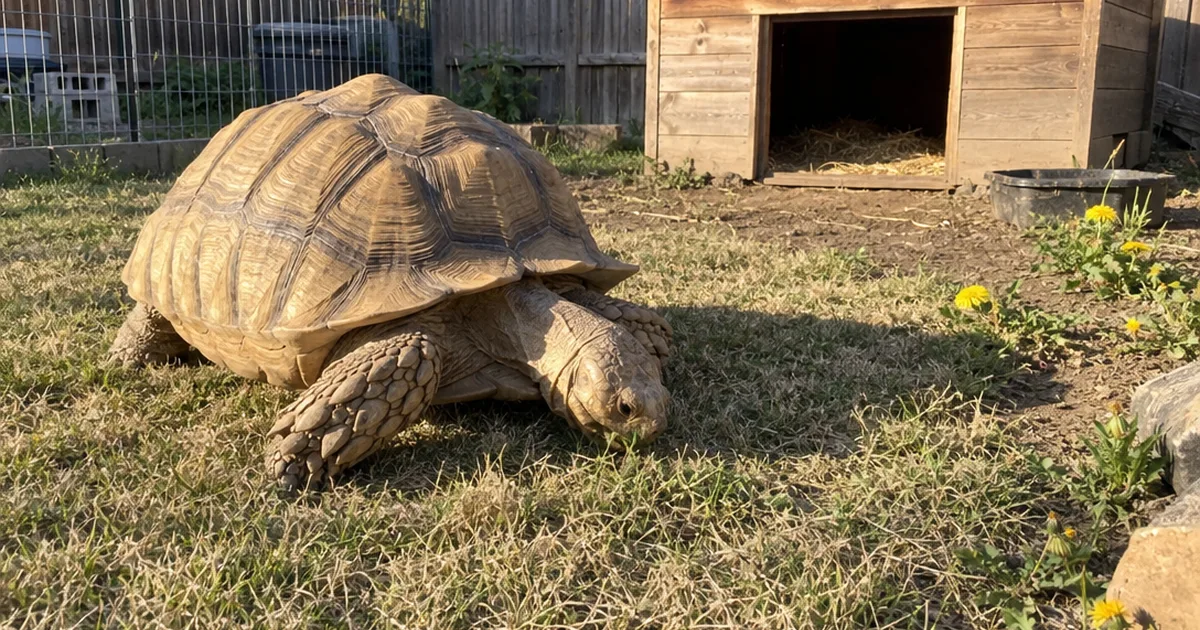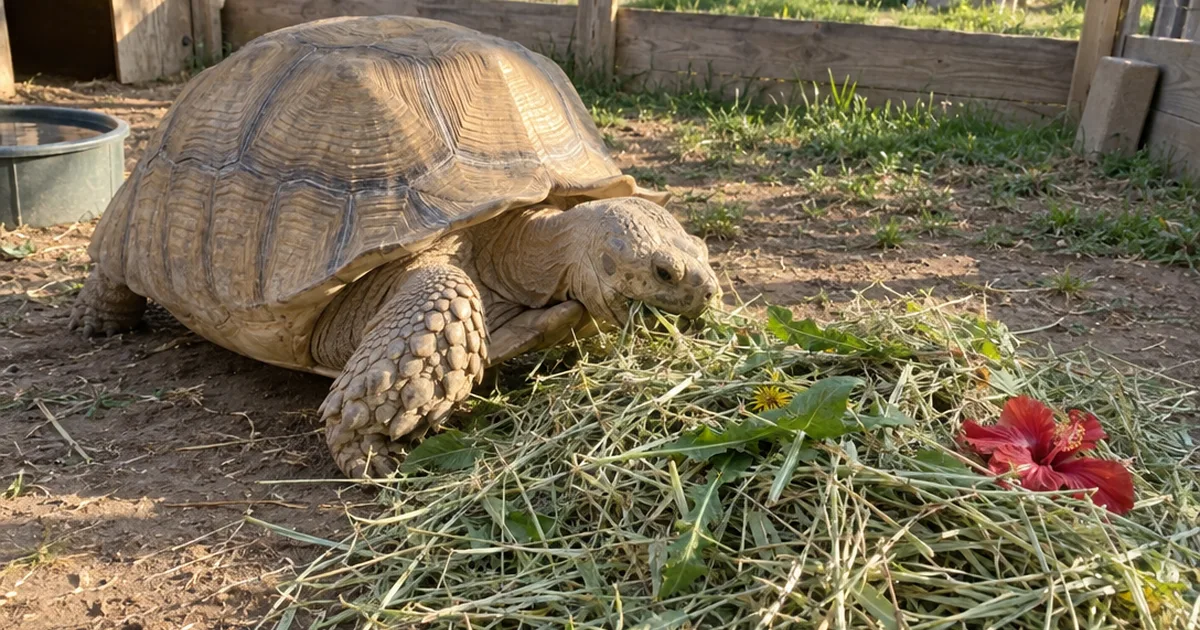
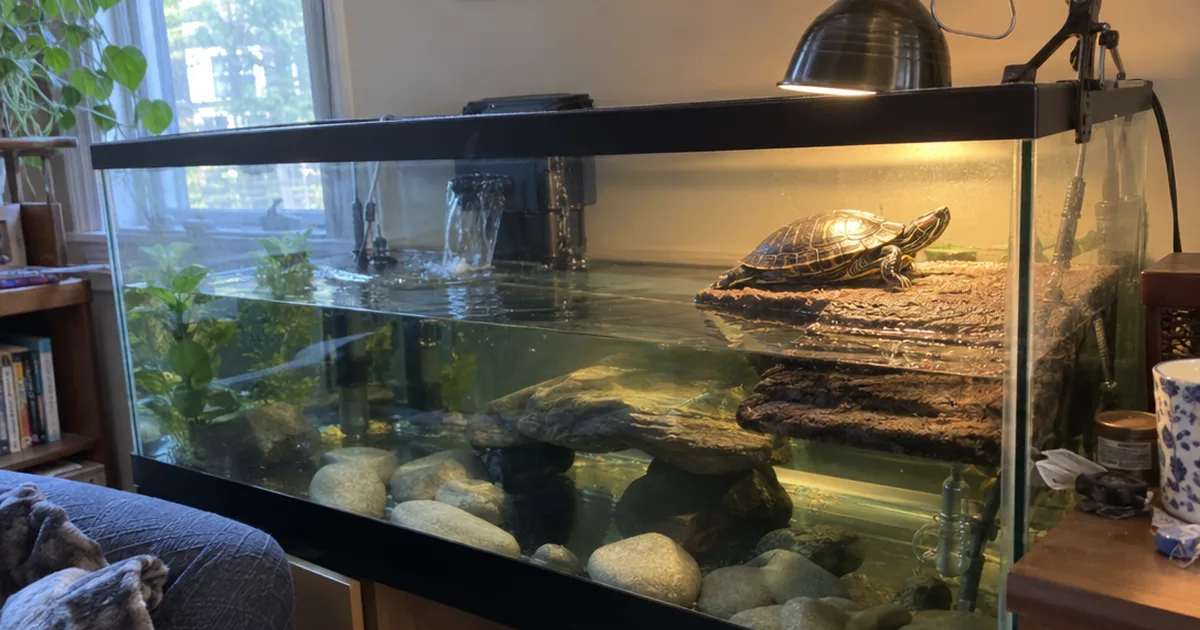
A 20-gallon tank holds a hatchling slider for about 2 years. After that, an adult slider needs at least 50 gallons, according to a care handout from Pender Veterinary Centre.
Most aquatic turtles reach adult size within 5 to 8 years, and every upgrade along the way means a new tank, filter and heater. Good aquatic turtle care starts with the adult turtle, not the baby in the box.
The 8 steps follow the order you’d set them up, each with the numbers exotic vets give for it. Once the tank is running, a 10-minute check of 6 readings shows you which step to fix first.
Here’s the short version:
- Best for: Owners ready for weekly water changes and a commitment of 20 years or more. Skip it if you want an animal to hold often.
- Time: This week for the setup, then a routine of daily, weekly and monthly jobs.
- First step: Identify your turtle’s species, then size the tank for its adult shell length.
How to Care for an Aquatic Turtle Step by Step
Caring for an aquatic turtle takes 8 steps: pick the species, size the tank for the adult, fill and treat the water, then heat a basking spot, heat the water and add UVB. After setup, the routine is filtering and changing water every week and feeding by age.
Step 1: Pick Your Species and Plan for Its Adult Size
Know your species before you buy a single piece of equipment, because adult size sets every number that follows.
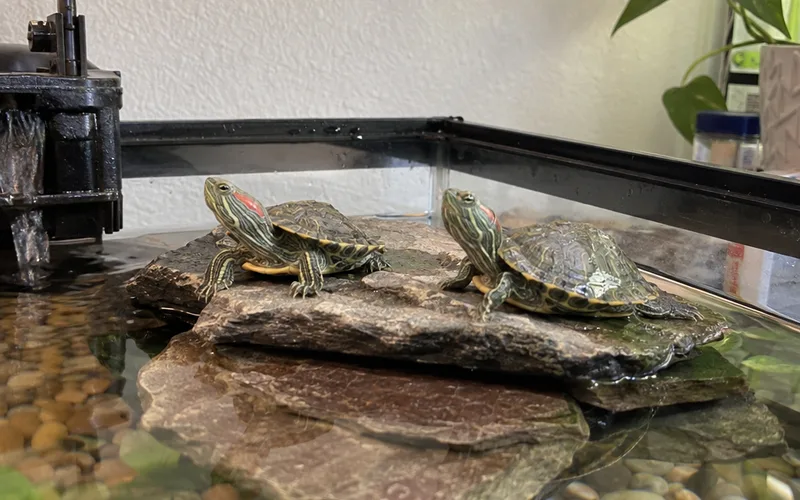
The red-eared slider is the most popular pet turtle in the United States, according to a PetMD care sheet by veterinarian Melissa Witherell, published September 27, 2024. Painted turtles and map turtles are the other species that sheet covers.
How big do they get?
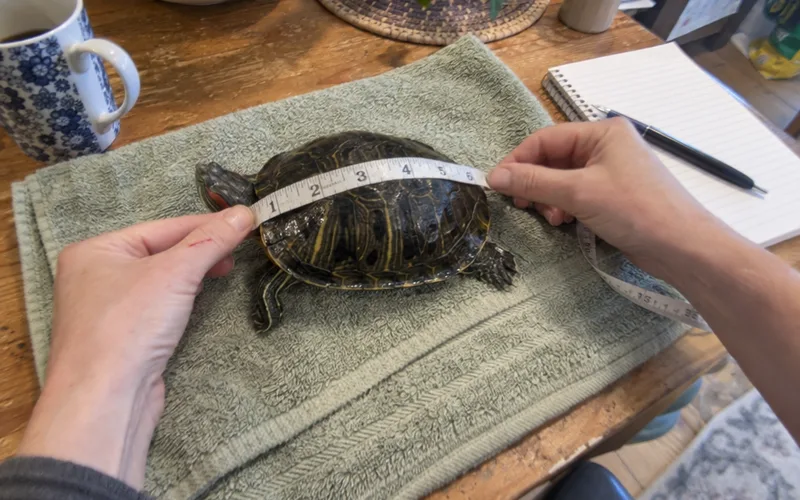
The U.S. Geological Survey lists a red-eared slider’s shell, the carapace, at 125 to 289 mm, about 5 to 11 inches. Pender Veterinary Centre adds that males are often smaller than females.
That range changes your tank by 60 gallons or more.
So check red-eared slider size by age and sex before you buy anything. Most aquatic turtles reach adult size within 5 to 8 years, the PetMD sheet notes, so you’ll keep upgrading until then.
Pender also lists mud and musk turtles among the popular species. Those stay smaller, and you can check how big a stinkpot gets before sizing a tank for one.
Every number in this guide follows from one fact: the shell length your turtle will reach as an adult.
One more check before you buy.
It’s illegal to sell turtles under 4 inches long as pets in the United States, Witherell writes. If a seller offers you a hatchling smaller than that, walk away.
Most of the numbers below fit red-eared slider care directly, since sliders are the default pet species.
Step 2: Buy a Tank Sized for the Adult Turtle
Give your turtle about 10 gallons of tank space for every inch of shell length.
That’s PetMD’s rule of thumb, and the same sheet calls a 40-gallon aquarium a good starting point for most turtles. A 4-inch turtle needs a 40-gallon tank at least 20 to 24 inches long and 16 to 20 inches wide.
Shape matters as much as gallons.
The enclosure should be at least 4 to 5 times longer and 3 to 4 times wider than the turtle, per the same sheet. A tall, narrow tank wastes water your turtle can’t swim across.
Now that you have the baseline, here’s the trap from the intro.
Pender Veterinary Centre says hatchlings may be housed in a 20-gallon tank but will outgrow it in 2 years. An adult slider then needs at least 50 gallons, and a 10-inch slider at 10 gallons per inch needs 100.
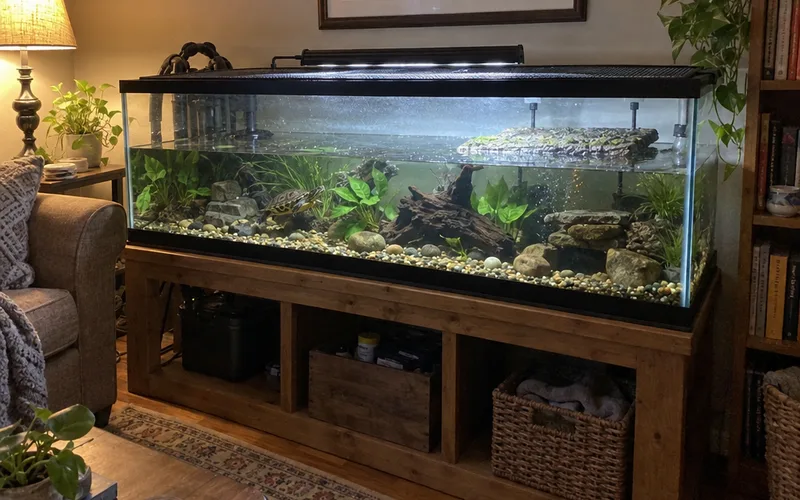
Buy for the adult if you can, because every upgrade means a new tank, filter and heater.
There’s also a floor-space check from Chicago Exotics Animal Hospital: the combined shell size of all turtles should not exceed 25% of the tank’s floor area.
Here’s how that works in a made-up example:
- Measure the shell. Say it’s 8 inches long and 6 inches wide, about 48 square inches.
- Multiply by 4. The tank floor needs at least 192 square inches.
- Check the footprint. A tank 24 inches long and 12 inches wide has 288 square inches, so it passes.
Cover the top too.
Some turtles are skilled climbers, so PetMD says the enclosure needs a screened lid to stop escapes. For layout options beyond a glass aquarium, browse these turtle tank ideas, then follow the full red-eared slider tank setup for a slider.
Step 3: Fill the Water Deep and Treat It First
Fill the tank so the water is about 1.5 to 2 times as deep as your turtle’s shell is long.
PetMD gives that depth because it lets the turtle swim comfortably and turn itself upright if it flips over. For a 4-inch turtle, that’s 6 to 8 inches of water.
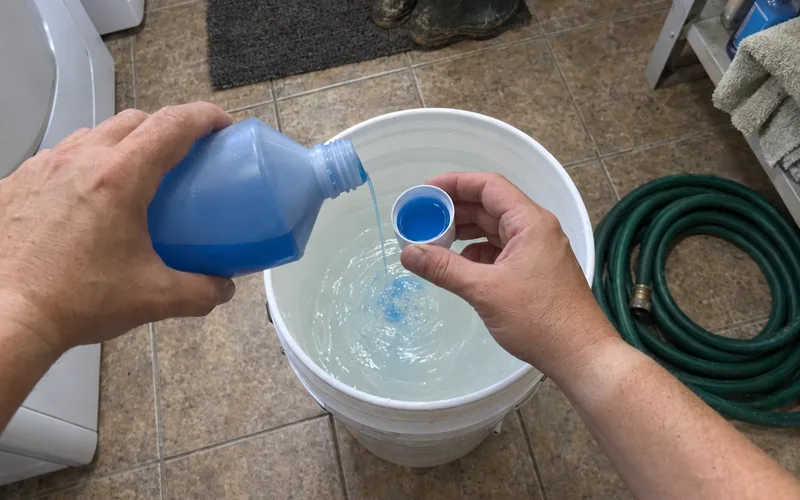
Don’t pour straight from the tap.
Before water goes into the tank, it must be treated with a turtle-safe water conditioner to remove chlorine and pollutants, PetMD says. Keep a bottle next to the tank so every refill gets a dose.
What about the bottom?
Chicago Exotics Animal Hospital recommends a bare-bottom tank. Gravel is harder to keep clean, and turtles often eat the smaller pieces, which can cause serious problems.
If you want a natural look, use rocks bigger than your turtle’s head, so it can’t swallow them. Skip sand too: Pender Veterinary Centre says sand has caused impaction, a gut blockage, in some turtles.
For greenery, pick from plants that are safe in a slider tank, and expect your turtle to eat some of them, as Pender notes.
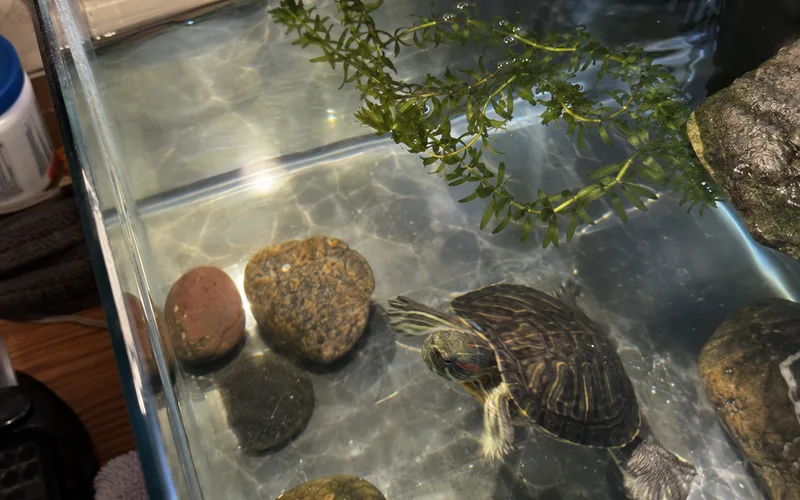
In other words, deep, dechlorinated water over a bare floor is the simplest setup to keep healthy.
Step 4: Build a Dry Basking Spot and Heat It to 85 to 95°F
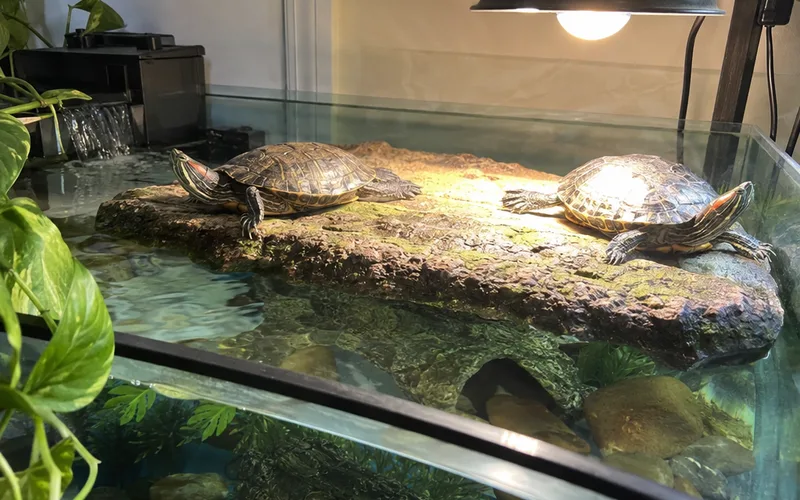
An aquatic turtle’s basking spot should reach 85 to 95°F, on a dry platform where the turtle can climb fully out of the water under a heat lamp.
That’s the PetMD range for the basking area, with the cooler end of the habitat around 75°F. The spread lets your turtle move between heat and cool water as it needs.
The platform itself has 2 jobs.
It must be easy to reach from the water, PetMD says, and Chicago Exotics Animal Hospital adds it must be sturdy enough not to collapse or tip and trap the turtle under water. A pile of stable rocks, a commercial dock or a DIY turtle basking platform above the waterline all work.
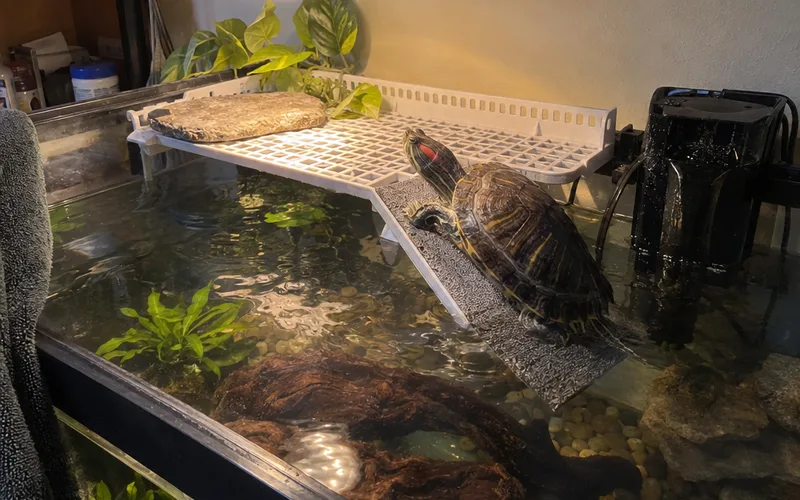
Then place the heat lamp over one end, outside the turtle’s reach.
How do you know it’s right?
Use 2 thermometers, one in the warm area and one in the cool area, as the PetMD sheet suggests. An infrared thermometer pointed at the basking surface gives you a fast reading too.
Note: Skip heat rocks. Pender Veterinary Centre says they tend to get too hot for most reptiles and can burn them.
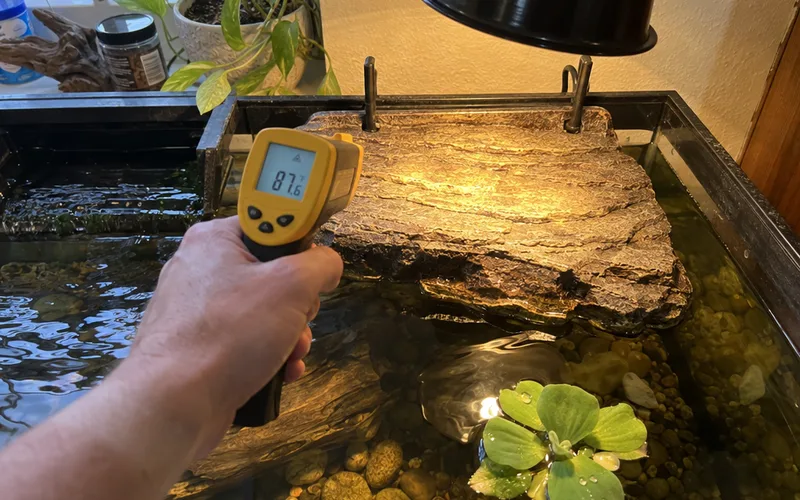
Key Takeaway: Measure the basking surface itself, not the air near the bulb, and adjust the lamp height until it reads 85 to 95°F.
Step 5: Keep the Water at 75 to 82°F With a Guarded Heater
Most aquatic turtles do well in water between 72 and 82°F (about 22 to 28°C), according to Pender Veterinary Centre.
Vets don’t fully agree on the exact target. PetMD suggests keeping the water at 75°F, while Pender recommends 82 to 85°F for sliders specifically.
So if you keep a slider, check the red-eared slider water temp range and aim for the warmer end.
Next, size the heater.
PetMD says aquarium heaters need 2.5 to 5 watts for every gallon of water, so a 40-gallon tank needs a heater between 100 and 200 watts. Pair it with a thermostat so the water can’t overheat.
Turtles bump into everything, including heaters.
Chicago Exotics Animal Hospital recommends a heater protector over the heater to prevent burns. Put the guard on before the heater ever goes into the water.
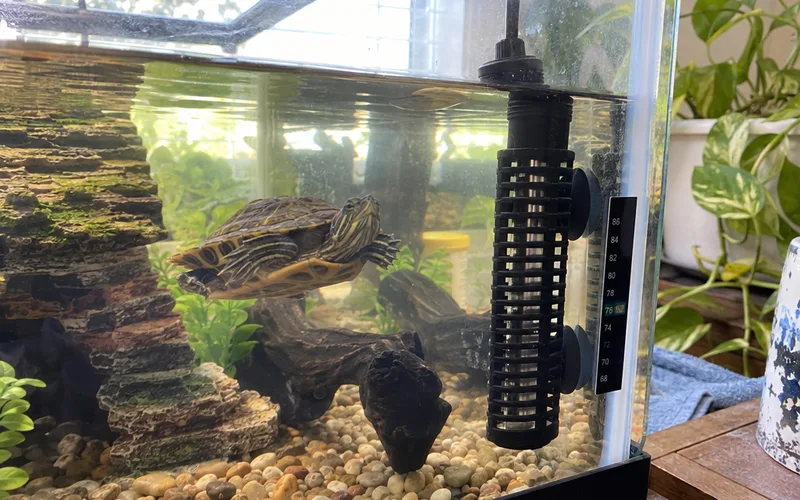
Here’s a simple routine:
- Check the water thermometer every morning.
- Match new water to the tank temperature before every water change.
- Recheck the reading after you move or replace the heater.
That second point matters because rapid water temperature changes can harm turtles, Chicago Exotics warns.
Step 6: Add UVB Light on a 10 to 12 Hour Timer
Aquatic turtles need UVB light every day, and PetMD recommends 10 to 12 hours of UV light daily to imitate natural sunlight.
Why does it matter?
Turtles need UV light to produce vitamin D in their skin, and vitamin D lets them absorb the calcium that keeps bones and shells healthy. Without it, a turtle is on the road to metabolic bone disease, where weak bones and soft shells develop.
Placement makes or breaks a UVB bulb.
Chicago Exotics Animal Hospital says fluorescent bulbs should sit no more than 12 inches from the basking site, on a timer for 12-hour light and dark cycles. There also shouldn’t be any plastic or glass between the bulb and the turtle, though a screen is fine.
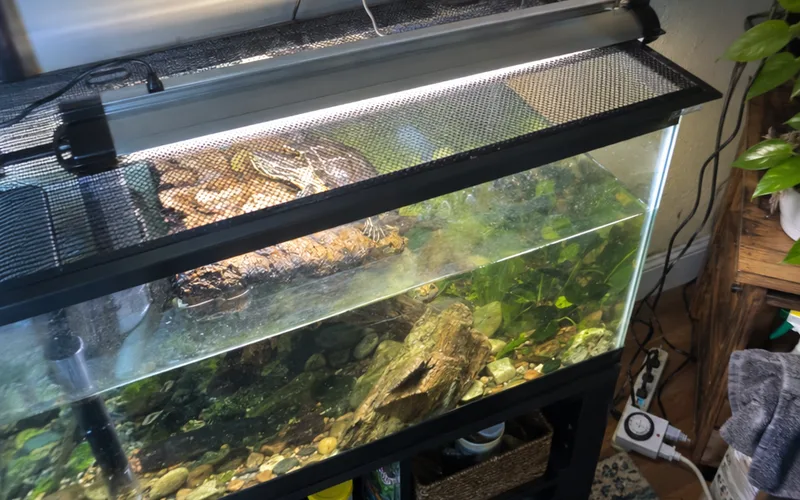
A UVB bulb behind a glass lid can glow all day and still give your turtle almost nothing.
The bigger question is when to replace it, and here the sources differ by bulb type:
- PetMD: replace UV lights every 6 months, even if the bulb still lights up.
- Pender Veterinary Centre: about every 6 months for strip or tube lights and every 12 months for coil bulbs.
- Chicago Exotics: every 6 to 12 months for fluorescent bulbs, and every 3 years for mercury vapor bulbs.
That last type is worth a look.
A mercury vapor bulb gives both basking heat and UV light from one fixture, Pender notes. So one bulb can do the job of a separate heat lamp and UVB tube.
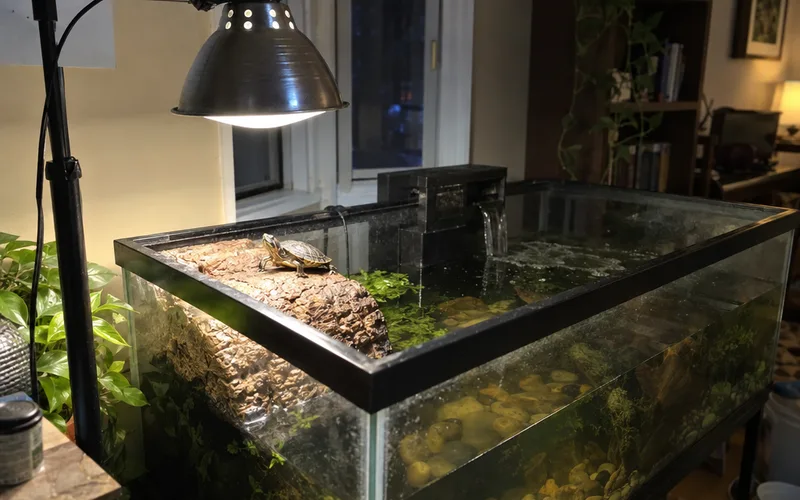
Pro Tip: Write the install date on the bulb base with a marker. Then you’ll know when its replacement window opens, since UV output fades before the visible light does.
Step 7: Filter Hard and Change Water Every Week
Pick a filter that can process all of the tank’s water at least 4 times per hour.
That’s PetMD’s standard. A tank with 40 gallons of water needs a filter that moves at least 160 gallons per hour (GPH), and if the next size up is 200 GPH, buy that one.
Which kind of filter?
Canister filters are recommended for turtle tanks, the PetMD sheet says, because they handle mechanical, biological and chemical filtration from outside the tank. Chicago Exotics Animal Hospital also accepts over-the-side filters.
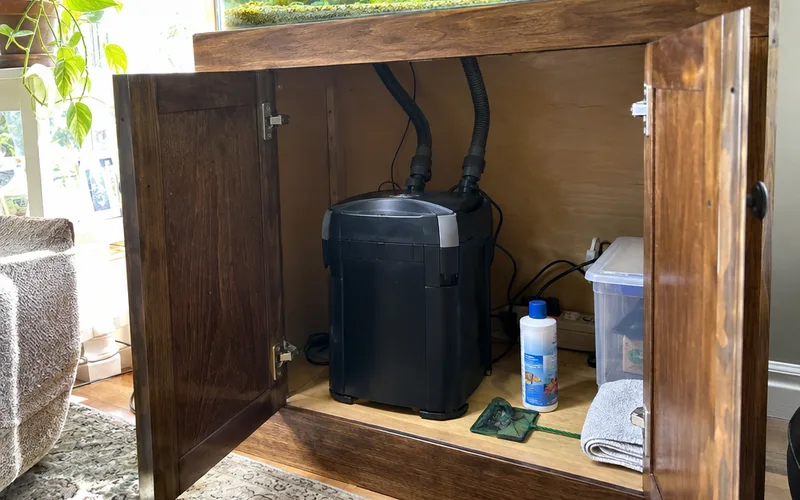
A good filter still doesn’t do the whole job.
Pender Veterinary Centre says filters reduce but don’t eliminate the need for water changes. Here’s the routine PetMD gives:
- Daily: Remove leftover food so it can’t rot in the water.
- Weekly: Change 25% of the water, or 50% every other week, with dechlorinated water at the tank temperature.
- Every 3 to 4 weeks: Deep-clean the enclosure, more often if more than one turtle lives in it.
Clear water can still be dirty, so test it.
A freshwater aquarium test kit measures the key numbers quickly, the PetMD sheet says. Its targets are ammonia at 0, nitrite at 0.5 ppm or less and as near zero as possible, and nitrate at 40 ppm or less.
What does a bad reading mean for you?
If ammonia or nitrite shows up, do a partial water change that day and check whether the filter is keeping up with the tank. If nitrate creeps past 40 ppm, your weekly changes are too small or too far apart.
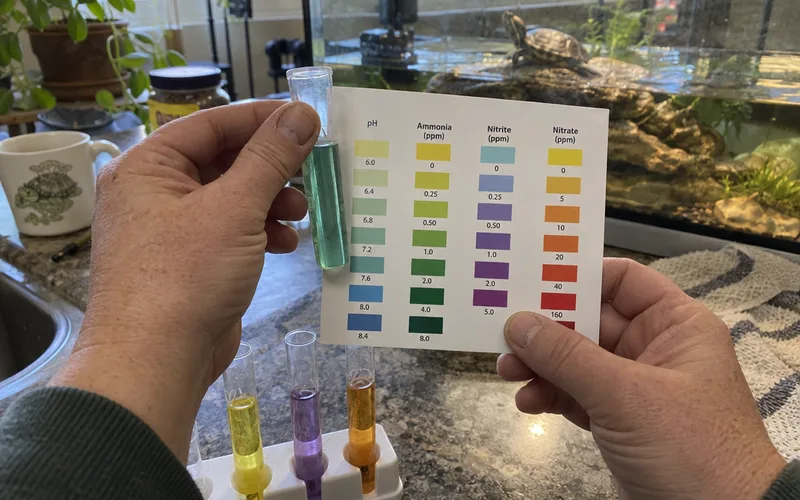
Why so strict?
Poor water quality can quickly cause shell infections or even death, according to Chicago Exotics. The same hospital says that if the tank water begins to smell, it’s already overdue for a change.
So if you can, feed your turtle in a separate container.
Pender says that cuts the waste in the main tank. It also means fewer pellets dissolving into the water between changes.
In other words, a big filter buys you clearer water, and the weekly change keeps it safe.
Step 8: Feed by Age, Then Balance Plants, Pellets and Protein
Feed juvenile aquatic turtles under 1 year old every day, and adults over 1 year every 2 to 3 days, the PetMD care sheet says.
That gap is easy to miss.
Juveniles need more protein for healthy growth, while adults need more plant matter to prevent unhealthy weight gain, Witherell explains. That’s why the schedule slows down after the first year.
Overfeeding has a real cost: Pender Veterinary Centre says obesity is common in captive turtles fed too much fat or given too little room to exercise.

What goes in the bowl?
Pender Veterinary Centre suggests a diet of about 50% plant material, about 25% commercial aquatic turtle pellets and about 25% animal or insect protein. PetMD puts leafy greens and other vegetables at 50 to 60% for adults and keeps treats, fruit included, under 10%.
Here’s what that looks like for an adult turtle fed every 2 to 3 days:
- Base: dark leafy greens such as kale, romaine or dandelion greens
- Pellets: a measured portion of aquatic turtle pellets
- Protein: earthworms or other live food a couple of times a week
- Treats: a few pieces of fruit now and then
Calcium needs a plan too.
Pender says calcium should be supplemented 2 to 3 times a week. If your turtle has a UVB light, that calcium shouldn’t contain vitamin D3, because the extra D3 upsets the calcium and phosphorus balance.
A cuttlebone floating in the tank is another easy calcium source, PetMD adds.
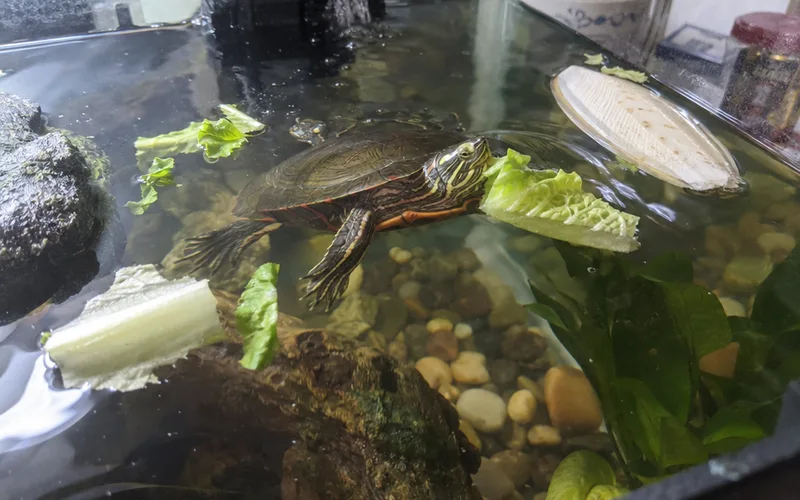
One caution on live food: Chicago Exotics says wild-caught sticklebacks and mosquito fish shouldn’t be fed, because they can carry serious parasites. Buy feeder animals from a store instead of netting them.
Feed in warm water too. PetMD says water in the upper 70s°F stimulates appetite and helps digestion.
For the full menu, see what a red-eared slider diet includes, which foods are safe if you wonder what turtles eat in a pond, and the kitchen staples that work when you’re figuring out what a turtle eats at home.
Does Your Aquatic Turtle Need Land or Just Water?
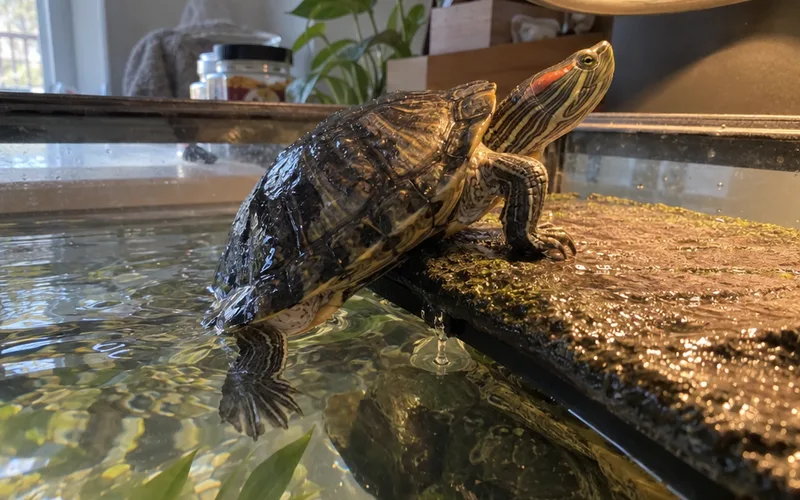
Most pet aquatic turtles need both, because the popular species are semi-aquatic. Pender Veterinary Centre says sliders, painted, map, mud and musk turtles split their time between land and water.
That’s why Step 4 isn’t optional for them.
Semi-aquatic turtles need a place to climb out of the water, dry off and bask, the clinic says. A turtle that can’t dry out fully under its heat lamp misses the warmth and UV it came out for.
A few species are different.
Softshell turtles and mata-matas prefer to spend most, if not all, of their time in the water, according to Pender. They still need warm, clean water, but the tank layout shifts toward swimming room.
So identify your turtle before you build the land area, and match the habitat’s dock size to how much time your species spends out of the water.
What You Need for an Aquatic Turtle Setup
An aquatic turtle setup needs a glass tank with a screened lid, a canister filter rated for 4 turnovers per hour, a guarded heater with a thermostat, a UVB bulb, a basking lamp and a dry dock. Size the tank, filter and heater for the adult turtle.
The smaller items are a water conditioner, 2 thermometers, a freshwater test kit, pellets and calcium without D3.
Price the filter and heater before you pick the tank.
Both are sized by the tank’s gallons, so a bigger tank raises all 3 costs at once, and it’s better to know that total before you buy.
How to Check Your Turtle Setup in 10 Minutes
You can check an aquatic turtle setup in about 10 minutes by measuring 6 numbers: tank size, water depth, basking temperature, water temperature, UVB hours and filter flow.
Grab a tape measure and a thermometer, then compare each reading with the step that sets it:
- Tank: at least 10 gallons per inch of carapace length (Step 2).
- Water depth: 1.5 to 2 times the shell length (Step 3).
- Basking spot: 85 to 95°F on the surface, and fully dry (Step 4).
- Water: 72 to 82°F, warmer for sliders (Step 5).
- UVB: 10 to 12 hours a day, no glass or plastic in the way, bulb inside its replacement window (Step 6).
- Filter and water: 4 turnovers per hour and no smell (Step 7).
Fix the first item that fails, then recheck the rest.
Tank size and the basking spot are the hardest to change later, so fix those 2 first.
How to Tell if Your Aquatic Turtle Is Sick
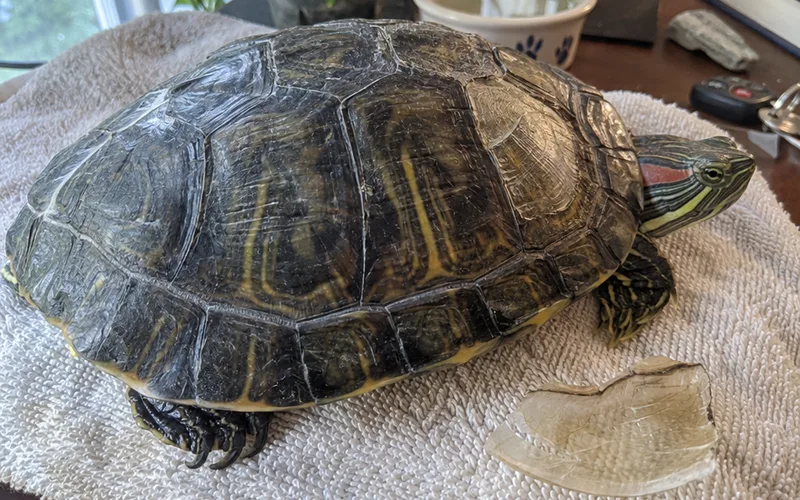
A sick aquatic turtle often shows swelling of the eyes, ears or head, discolored spots, bleeding or discharge, according to Pender Veterinary Centre. PetMD adds scrapes, dents or soft spots on the shell, and any of these signs means a visit to a reptile vet.
Don’t wait for a second symptom. Reptiles often hide illness until it may be too late, Pender warns, so small changes count.
Appetite matters too.
A turtle that stops eating for a long stretch needs a vet, because not eating isn’t one disease but a symptom of many, from parasites to a poor setup.
Regular checkups catch problems earlier.
Pender recommends an initial exam for any newly acquired turtle, an annual physical every 12 months after that, and a fecal sample checked for internal parasites. Book the first one in the same month your turtle comes home.
The shell needs special care.
It’s part of the skeleton, so Pender says a shell fracture is as serious as a broken bone, or more. You can learn what a healthy red-eared slider shell looks like, and how turtle shell rot starts, so you can spot the difference early.
And watch the dog.
The most common household hazard for turtles is dogs, according to Chicago Exotics, and a dog can easily puncture the shell. Keep your turtle’s tank and any outdoor time well away from pets.
Can You Get Salmonella From a Pet Turtle?
Pet turtles can pass Salmonella to people even when they look healthy. Pender Veterinary Centre says it’s safest to assume your turtle is always shedding the bacteria.
That doesn’t mean you can’t keep one.
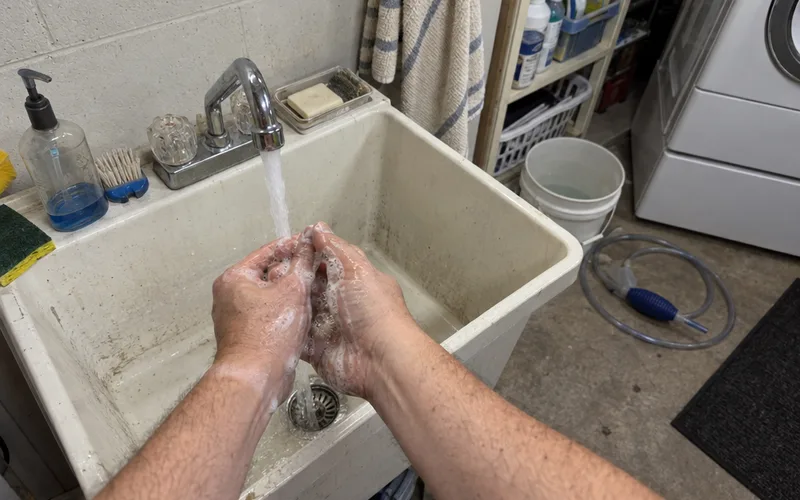
It means hygiene is part of aquatic turtle care. Pender says to wash your hands after handling your turtle, and the same goes for tank water, decor and the filter.
Who needs the most care?
Children and people with weakened immune systems are more at risk of serious illness from Salmonella, the clinic notes. So supervise kids around the tank, and clean equipment away from the kitchen.
Here’s the habit to build: tank job first, then soap and water, then anything else.
Can You Handle a Pet Aquatic Turtle?
An aquatic turtle can be handled, but keep it brief and only when needed. In general, aquatic turtles don’t enjoy being handled often, PetMD says.
Give a new turtle at least a few days to settle in before you pick it up, the same sheet adds.
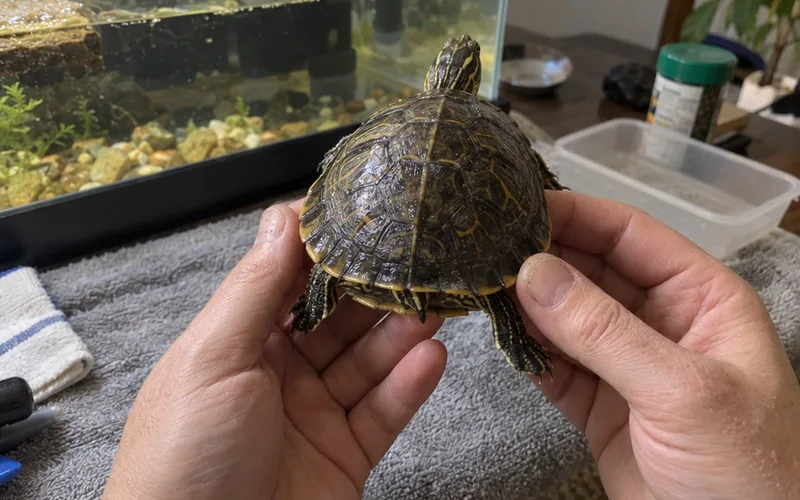
When you do lift it, support it with 2 hands from underneath, legs included, as Pender Veterinary Centre advises. Keep it low over a table, since even a short fall can cause serious injury.
Expect some resistance.
Many aquatic turtles are less comfortable with handling than land turtles and may bite if mishandled, Pender notes. So keep your fingers away from the head and set the turtle down if it starts to struggle.
Can Two Aquatic Turtles Live in the Same Tank?
Two aquatic turtles can share a tank only in some cases: PetMD says males tend to fight and shouldn’t live together. For some species, females of the same size can share a tank, though they may fight too.
If you try it, PetMD says to increase the tank dimensions by 25% for the extra turtle. The floor-space rule from Step 2 still applies, and it counts both shells together.
Two more rules:
- Never house different species in the same enclosure, the PetMD sheet warns.
- Watch closely after you introduce them, and separate them into different tanks if they fight.
Size the dock for both. Pender Veterinary Centre says the basking area needs room for every turtle in the tank to climb out at once, so one turtle never blocks the other from the heat.
How Long Do Aquatic Turtles Live?
Aquatic turtles live 20 to 40+ years with proper care, depending on species, according to PetMD.
The species changes that number a lot. Pender Veterinary Centre lists sliders at 15 to 30 years, mud turtles at 10 to 15 years and the spiny softshell at up to 50 years.
What does that mean for you?
A turtle bought for a 10-year-old can still be alive when that child turns 40. Plan who takes over if you move, go to college or can’t keep it.
Care quality decides where in that range your turtle lands. The factors behind red-eared slider lifespan in captivity are mostly the steps above: space, heat, UVB, water and diet.
Are Aquatic Turtles Good Pets for Beginners?
Aquatic turtles are a fair choice for a prepared beginner, but they aren’t easy. The PetMD care sheet from September 2024 rates their care difficulty as intermediate.
Here’s the deal:
The daily jobs take minutes, but the weekly water changes and a lifespan of decades are the real commitment. If you’d rather compare options first, read whether turtles are good pets for your household, or weigh them against other semi-aquatic reptiles people keep.
If a turtle becomes too much, never release it.
The U.S. Geological Survey says red-eared sliders are introduced outside their native range primarily through pet releases and escapes. Rehome yours through a rescue or your vet instead.
Keeping a land turtle or tortoise as well? Their heat, water and diet needs differ, so set them up from the turtle and tortoise care basics instead of this tank routine.
Frequently Asked Questions
Do pet turtles need to live in water?
Most pet aquatic turtles need water and land: Pender Veterinary Centre says semi-aquatic species such as sliders split their time between the two and need a place to climb out, dry off and bask. A few, such as softshells, spend most or all of their time in the water, so check your species before setting up the tank.
Are turtles happy in a tank?
Happiness is hard to measure in a reptile, but a tank that meets the numbers vets give covers what an aquatic turtle needs: about 10 gallons per inch of shell, a dry basking spot at 85 to 95°F and 10 to 12 hours of UV light, per PetMD. A turtle that eats, basks and swims normally in that setup is getting what it needs.
Can you use tap water in a turtle tank?
Yes, tap water works in a turtle tank once you treat it. PetMD says water must be treated with a turtle-safe water conditioner to remove chlorine and pollutants before it goes into the tank, and new water should match the temperature of the tank water.
Should a turtle tank light stay on at night?
No, a turtle tank’s lights should go off at night. Chicago Exotics Animal Hospital puts UVB bulbs on a timer for 12 hours of light and 12 of dark, and Pender Veterinary Centre says night temperatures should drop by no more than 5 to 10°F.
What is the ideal turtle tank temperature in Celsius?
Most aquatic turtles do well in water around 22 to 28°C, the Celsius version of the 72 to 82°F range from Pender Veterinary Centre. The same clinic suggests 28 to 29°C (82 to 85°F) for sliders, with a basking spot near 29 to 35°C.
What should you do with a turtle you can't keep?
A pet turtle you can’t keep should go to a turtle rescue, a reptile club or your exotics vet, never outdoors. The U.S. Geological Survey says pet releases and escapes are the main way red-eared sliders end up living wild outside their native range.
Final Thoughts
Aquatic turtle care comes down to 4 numbers: 10 gallons per inch of shell, a basking spot at 85 to 95°F, 10 to 12 hours of UVB and a 25% water change every week.
This week, measure your turtle’s shell and check that your tank, heater and filter fit its adult size, not the size it is today.